

By Sarah CR Clark
Paul Hueg has been an auto mechanic at Park Service on Como Avenue in St. Anthony Park for a long time. But Hueg has cared for animals even longer.
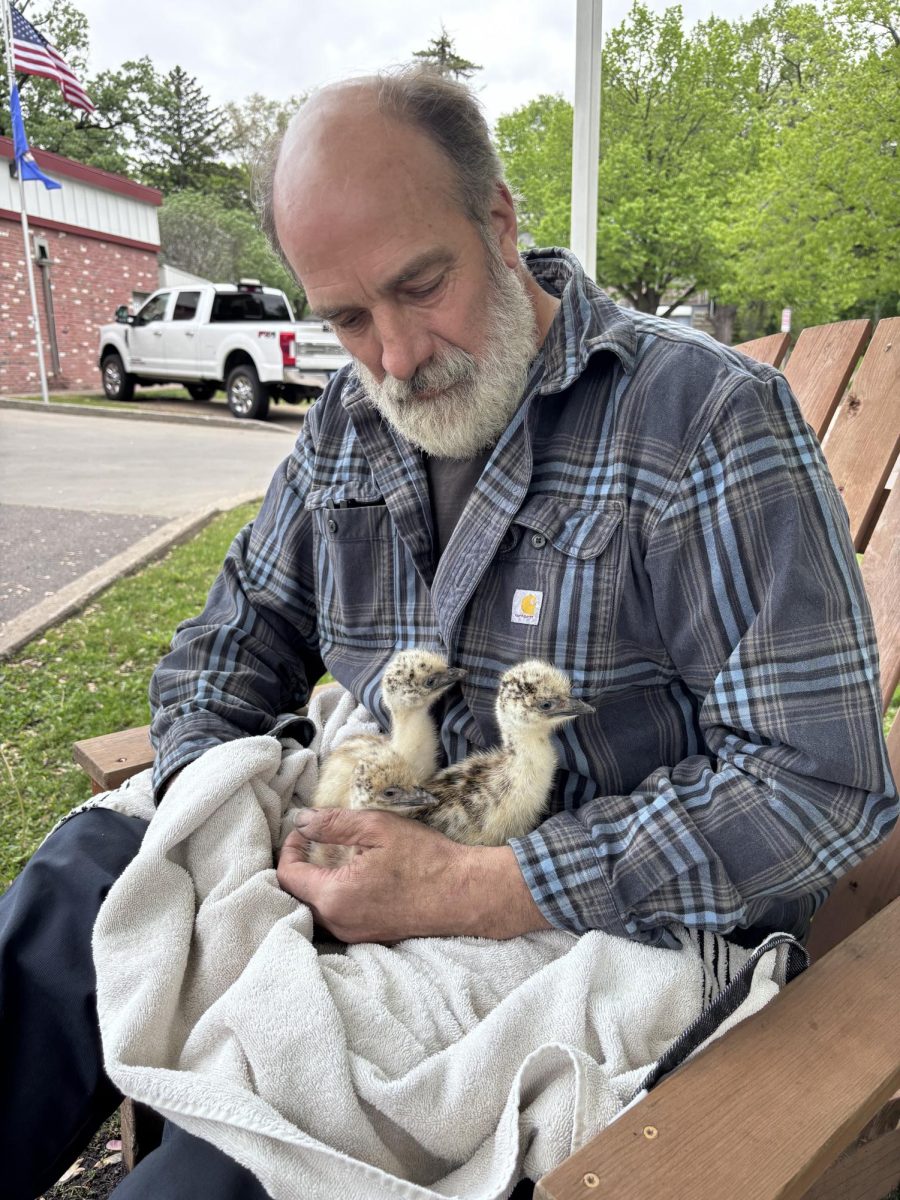
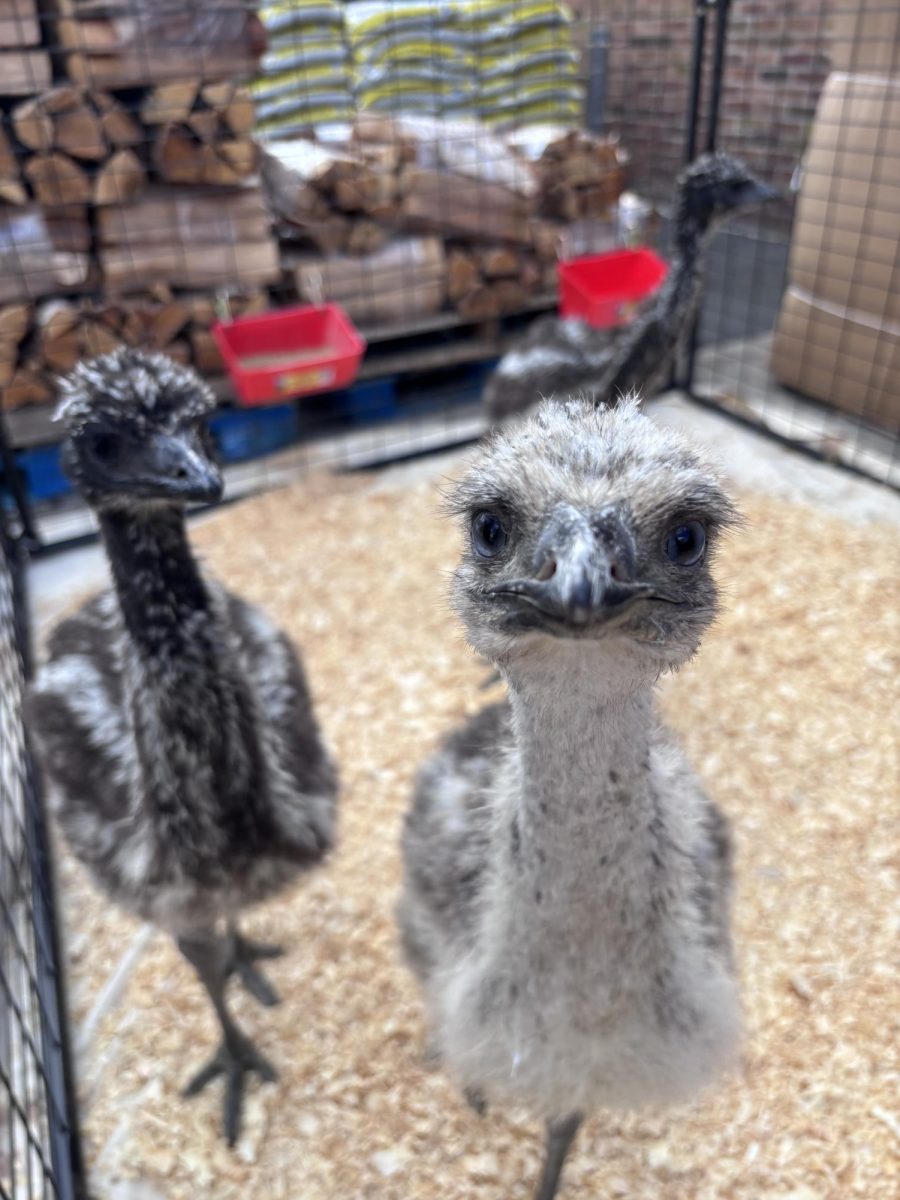
Recently Heug acquired a breeding pair of emus and spent this spring raising his first brood of emu babies. Neighbors had the opportunity to meet Hueg’s three young emus at Speedy Market’s May anniversary celebration.
Hueg lives in Hammond, Wisconsin, on Sunset Elk Ranch where he built his own house. Besides emus, Hueg raises American Blackbelly sheep, Painted Desert sheep, Nigerian Dwarf goats and laying chickens representing 15 different breeds. (This isn’t the first Bugle story featuring Hueg’s animals. See July 2021’s story on the lamb named “Blaze.”)
At the May Speedy celebration, Paul and his wife Lynn showed off their young brood of emus—named Ducky, Petry and Littlefoot. All three bird names were inspired by the movie “The Land Before Time.”
Paul and Lynn reported that Sunset Elk Ranch’s emus and chickens are both the result of Lynn’s desire for green eggs.
“Lynn didn’t want any chickens that laid white eggs,” Paul explained. “And she really wanted some chickens that laid green eggs.”
So Hueg googled “What bird lays green eggs?” and the first result was a link to emus.
While Lynn’s chickens’ eggs are a lighter olive green, Paul’s emus’ eggs are deep emerald and massive in size. One emu egg weighs about a pound and a half, equaling about a dozen chicken eggs.
“The yolk is darker yellow and would be much richer,” Hueg reported. “I’ve never tried any of my bird eggs,” he said. “We used to have peacocks, quail, pheasants and all of that. Everything I have is for my entertainment, not for my meals. Except for the chicken eggs—those are for breakfast,” he laughed.
Hueg grew up in St. Anthony Park, on Gordon between Hillside and Commonwealth. “My parents moved there in 1957. They bought our house from Bud Grant, the Vikings coach. My parents came from Michigan when my dad got a job here at the university.”
Hueg worked at Speedy Market all through high school. He started working at Park Service for the first time in 1982, then after a few years he worked for some auto dealerships, but came back to Park Service in 1996. April 2026 marked his 30th year there.
Along the way, Hueg had a long-standing interest in pets, from dogs to gerbils to a guinea pig, and any other animals in the neighborhood that needed care.
“When kids were doing other stuff on MEA weekend, I’d be up at the Raptor Center working there,” Paul recalled. “I thought I’d become a vet, but I liked doing mechanical things as well. So, I kind of do my own vet stuff at home now.”
Breeding emus
Hueg purchased his breeding pair of emus in March 2025. The six-year old female, blonde in color, is named “Blondie.” The male, “Dagwood,” is five years old and the standard brown color.
Female emus lay their eggs during Minnesota’s winter. (Emus are native to the southern hemisphere, which may partly explain the odd-seeming timing of their egg laying.) During her 2026 laying season, Hueg’s Blondie laid one egg every three days beginning in January.
“Between 5:30 and 6:30 at night, there’d be a new egg,” Hueg said. “I could go out there like clockwork, and it would be right there. I would go out there because it was dark and cold and if I waited until morning, the egg would have frozen.”
In the wild, male emus incubate the eggs for about 60 days and care for their young for up to two years.
At Sunset Elk Ranch, Hueg collected his emus’ eggs to keep in an incubator. Blondie laid a total of 26 eggs this winter. Hueg kept seven, sold 17 to folks interested in raising emu, and two eggs were not viable.
The young emus eat a high protein diet. During an interview that included three emus that hatched around Mother’s Day, Hueg explained, “These guys eat a 20% protein pellet. And that’s all you give them. Because they’ll grow about a foot a month until they’re full grown, so they need that extra nutrition.”
Hueg’s adult emus enjoy a different kind of mineral pellet along with plenty of fresh produce—apples, bananas and grapes, often sourced from Speedy Market, and shredded carrot scraps from Lanna Thai Restaurant.
“They do really well into the minus 40s in the winter. They stay outside because they don’t like going into shelters,” Hueg explained. He has a lean-to for his emus but they often choose to lay their eggs in a pile of hay.
“Even when it’s snowing, they’ll lay there. They’ll just shake the snow off and go about their day,” he said. “They’re a tough bird.”
“The biggest thing about their pens,” Hueg said, “is to give them space. They need exercise and they like to run.”
Emus can run as fast as 33 miles per hour. Hueg’s bird enclosure provides an ample runway at 150 feet long and 40 feet wide. n
Sarah CR Clark lives in St. Anthony Park and is a regular feature writer for the Park Bugle.
