By Kathy Henderson
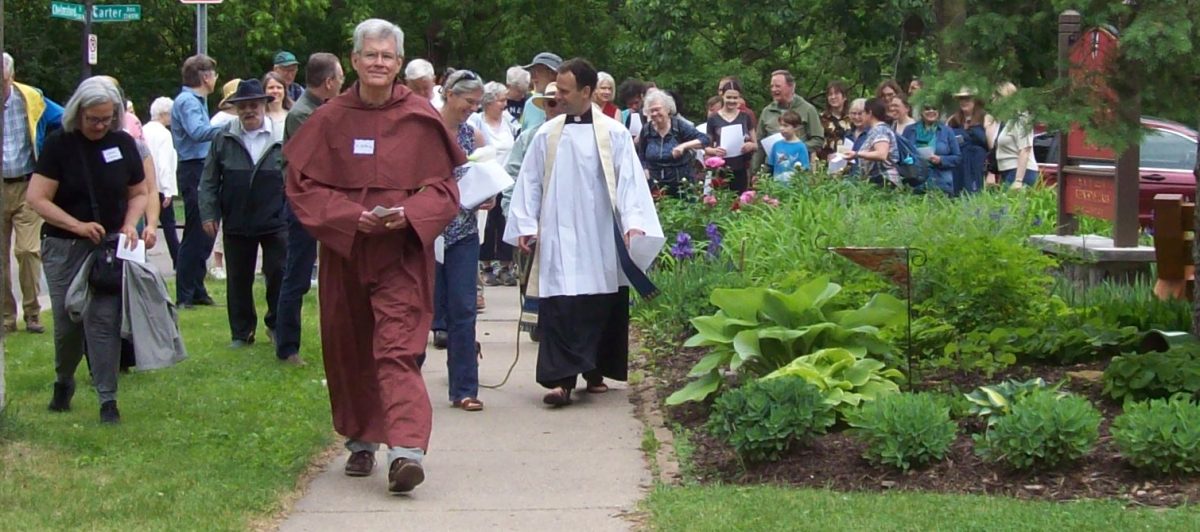
A casual observer might have questioned what was going on upon seeing an unusually long line of people walking through St. Anthony Park late Sunday morning, May 31. It was too early for the Fourth of July parade, too peaceful for a political demonstration and too fast paced for a nature walk.
A giveaway might have been the presence of a lead person wearing a brown friar’s robe and carrying a lily. Another hint was the number of people in clerical attire sprinkled among the walkers.
The answer is that it was the St. Anthony Park Faith Communities Moveable Feast Procession, made up of congregants and leaders from five neighborhood churches.
This first-time interdenominational gathering, in recognition of the feast day of St. Anthony, began at the plaza in front of St. Anthony Park Lutheran Church on Como Avenue. It proceeded to St. Matthew’s Episcopal Church on Carter Avenue, then went across the alley to join with those waiting at St. Anthony Park United Church of Christ on Commonwealth Avenue.
Continuing down Commonwealth, the procession, now made up of members from three congregations, crossed Como Avenue to arrive at Centennial United Methodist Church on Hillside Avenue.
With four congregations in the procession, the final trek took them meandering through Langford Park, walking briskly along Raymond Avenue and passing the Hampden Park Co-op to St. Cecilia’s Catholic Church on Bayless Place, where the St. Cecilia’s congregation hosted a sandwich lunch.
At each stop, there was singing of energizing songs, often with lyrics reflecting journey, travel, pathway or road, including the familiar “When the Saints Go Marching In.”
In recognition of St. Anthony as the patron saint of good harvests, the moveable feast theme reflected wheat, and food shelf donations of store-bought bread items and bread-making ingredients (flour, salt, oil, yeast) were collected.
Dan White, who was wearing the friar robe and taking on the St. Anthony persona for the procession, was one of many people that day who commented on how unusual it would have been in the past for the congregations to commingle, and how much they appreciated that the attitude of separation was fading away.
“I began attending St. Matthew’s in 1964, when I was 12,” said White, who grew up near Como and Raymond. “For almost all that time, the local parishes treated each other like space aliens. St. Matthew’s and the United Church of Christ backed up to each other over an alley, and we still had nothing to do with each other. All that changed when the ministers at St. Anthony Park Lutheran organized the St. Anthony Park Faith Communities about three years ago. Now we have monthly meetings and coordinate on a wide range of issues.”
According to a “Ramsey County History” magazine story, “St. Anthony Park most likely derives its name from its early close association with the village of St. Anthony,” established as a township near St. Anthony Falls in 1861.
In 1680, Father Louis Hennepin, a Catholic friar from Belgium, named the falls on the Mississippi River—known as Owámniyomni in the Dakota language — after his patron saint, St. Anthony of Padua, a saint often associated with travelers and a finder of lost people and items. It seems fitting then that the congregations of St. Anthony Park have at long last found each other.
Kathy Henderson lives in St. Paul and is a freelance writer for the Park Bugle.
