
What will stay? What will go?
By Ann Juergens
Analysis
Earth-shaking change is coming to Falcon Heights, Lauderdale and St. Anthony Park.
It will affect us all, from Roselawn Avenue on the north, across Larpenteur, to Como Avenue on the south, and everywhere in between.
It will increase traffic, could alter access to the business district and bring unfamiliar density to our communities.
The good news is that we will soon be sharing our neighborhoods with many more residents, which is precisely what we should be doing.
The hard work comes in our mission, which, as engaged citizens, is to influence those large institutions selling their land and the developers seeking to transform it.
Future together
In so doing, we must envision a future together that welcomes more homes, yet also recognizes the threat of climate change and prioritizes stewardship of our green spaces, tree canopy and watershed.
All told, about 167 acres — the Luther Seminary’s 26.6-acre campus and the University of Minnesota’s 141-acre golf course — will, over the next two to 10 years, change. By comparison, the Highland Bridge project at the former Ford Plant is only 122 acres.
Operating in St. Anthony Park since 1904, the seminary’s student body has diminished over the decades, so shrinking its physical plant makes sense. Its land comprises two parcels. The 16-acre Lower Campus sits to the north and west, bumping up toward Hwy. 280 and Larpenteur Avenue. That includes a classroom building, a dormitory and a row of houses along Fulham Street.
Significantly, the long-neglected seven-acre Breck Woods in Lauderdale rests on that parcel, too, with mature trees, a watershed pond, trails and abundant wildlife.
The seminary signed a purchase agreement this spring with Lifestyle Communities, Inc. Lifestyle developed the Zvago Co-op, which opened in 2019 on land previously sold by the seminary.
Lifestyle’s most recent plan for the Lower Campus includes the construction of 223 residential units: 68 co-op units, 108 “courtyard flat” condominiums, 30 other condominiums and 17 single-family houses.
At a Sept. 4 presentation before the St. Anthony Park Community Council Land Use Committee, the developers touched on many issues, from long-term maintenance of green spaces and trees to sources of heating, public access, affordability, parking and traffic.
Many steps remain, among them: St. Paul and Lauderdale site plan approvals, traffic flow resolution, a potential zoning variance and watershed permissions. Still, the Seminary and developers hope to close the purchase as early as spring 2026.
Meanwhile, the Seminary put its remaining 10-plus-acre Upper Campus on the market in July. It contains 13 buildings, including nine houses and four structures, two of which — Bockman Hall and the old Muskego Church — are on the National Register of Historic Places. The land is entirely in St. Paul and extends into a large green wooded lawn along Como Avenue that the community has long shared in a kind of social contract with the seminary. The Arts Fair, Fourth of July parade, ice cream social, SAP Lutheran Church, and many children, walkers and bicyclists have long used that green triangle for gatherings, play and as a natural pathway into our vibrant shopping village.
The seminary states that it is not interested in dividing the Upper Campus into smaller pieces to sell, for example, as individual houses, or the great lawn as a park.
University golf course property
And then there’s the University of Minnesota’s sale of its Les Bolstad Golf Course, a substantial landscape of rolling hills, ponds and old trees. It straddles Larpenteur Avenue in Falcon Heights. University golf teams have not competed on the course for many years. The U will welcome the cash, too.
Falcon Heights and Ramsey County have declined to buy this land from the university. It will be sold to developers.
A Falcon Heights Visioning Committee is developing goals to include in the University’s Request For Proposals to developers. One vision consists of 1,500 units built on the golf course.
But how? Confine construction to tall buildings on the fairways to save trees? Preserve the course’s rolling contours to let the land do its work of absorbing water? Preserve park and trails around and through the golf course? Or bulldoze the land flat in the arguably mistaken notion that doing so would make it easier to develop?
These are among the questions in need of sensible answers.
The seminary and university don’t pay a penny in property taxes. For-profit housing or commercial development will generate much-needed tax-base increases for our cities.
All three cities have approved 2040 Comprehensive Plans, with St. Paul and Falcon Heights also committed to Climate Action Plans. The proposed developments should adhere to these plans, which include goals such as increasing clean energy usage, citywide carbon neutrality by 2050 and protecting natural ecosystems.
It all may seem like a disparate set of “deals” to be configured by motivated sellers and eager buyers, focused on the monetary value of land, homes and taxes. But these transactions must be driven by our community values.
The lands are connected to each other and so are we. As neighbors from Falcon Heights, Lauderdale and St. Anthony Park, we each might have our self-interests, but together we can raise our voices to our city councils, to mayoral candidates, to the SAP Community Council, at various public information forums and planning commission meetings, to other city and county elected officials, to the seminary, the university and the Capital Region Watershed District.
Ideally, with our elected officials, we can urge developers to collaborate, aiming for a harmonious result that includes environmental health with public access, parks, trees and trail corridors throughout for neighbors current and new to enjoy.
In the end, this is more than a complex business tale of “many moving parts.” What’s at stake is a once-in-a-lifetime renewal of our region.
What fresh future do you want to see — do we want to see — amid this rapid and inevitable change?
Ann Juergens is a director of Friends of Breck Woods and a resident of Zvago SAP Cooperative.
—-
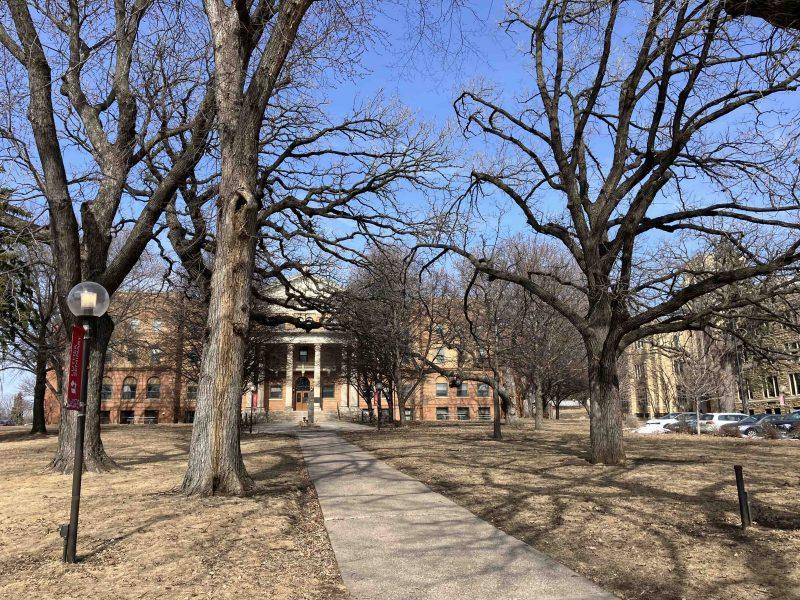
Cutline for a Seminary photo from the archives: One of many green spaces at Luther Seminary. Photo by Janet Wight.
Dan B • Nov 16, 2025 at 4:58 am
The best thing in the long run would be high density up the wazoo. Waymu transport and easements for parks and trails/sidewalks. The ag field campus should shift to Morris MN and open up more land. Free rides to Roseville and the midway and both downtowns. Money from the golf course sale should not be diverted to the U of MN football team. Also quit wasting money on the women’s ice hockey team. It should go to a large well ventilated accesible public library with an exercise community center. Perhaps a few tall mcmansions for the property tax revenue. Also Solar panels on roofs.
Even if something like this fails a bit at least we tried. Also uses futuristic name not something mired in the past!
Dan Buechler • Nov 15, 2025 at 9:13 pm
I am mostly interested clear concrete language first. Probably sidewalks, and perhaps a path with some crushed limestone and shade trees. Better access to Larpenter and their busses on a higher frequency. Perhaps a small bus like you see in some sububs could be a waymo.