

By Janet Wight
Earlier this summer, a weird smell emanated from inside the Marjorie McNeely Conservatory at the Como Zoo.
Call it putrid, rancid or foul, the smell was not reminiscent of the usual beautiful fragrances wafting through the air at the venerable botanical gardens.
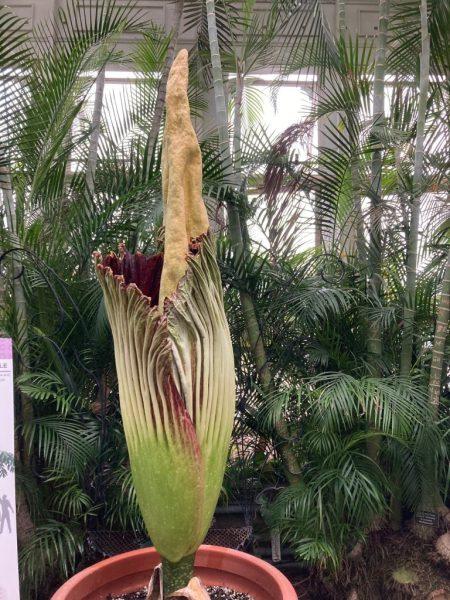
No, for a few glorious days in late June, conservatory visitors were feted to the putrid smell from Fredrick the Corpse Flower, a plant native to the rainforests of Sumatra, Indonesia.
From a tiny seedling, this corpse flower slowly grew over a period of several years and then finally bloomed in late June, releasing a foul-smelling odor.
To learn about the story of Frederick the Corpse Flower, the Bugle conducted a Q and A interview with Matt Reinartz, marketing and public relations manager for Como Park Zoo and Conservatory. The transcript has been edited for clarity and brevity.
Q: How long has the Conservatory had Frederick the Corpse Flower and where did it come from?
A: We have had Frederick since 2017 when he arrived as a seedling donation from the Greater Des Moines Botanical Garden.
During our more than 100-year history, the Marjorie McNeely Conservatory has had a few corpse flowers come through our collection.
Frederick and sibling Horace are the first to bloom here in recent memory, which makes them very special residents. They were each only a few months old when they arrived.
Q: What’s the story behind the name Frederick?
A: We chose the name Frederick to honor Frederick Nussbaumer, a visionary who played a key role in the development of Como Park.
Nussbaumer worked as a gardener before being elevated to superintendent of the City of St. Paul park system in 1891, a role he held until 1922.
He helped shape Como Park into the iconic urban green space it is today. Naming such a rare and majestic plant after him felt like the perfect tribute.
Q: Who was responsible for caring for Frederick?
A: It was a collaborative effort by our horticultural team. Jen Love, one of our many horticulturists, was especially involved in the care and cultivation of Frederick. That said, bringing a titan arum to bloom is a true team accomplishment, from repotting and monitoring growth to managing public viewing and education.
Q: Where are these plants found in the wild?
A: The corpse flower (Amorphophallus titanum) is native to the rainforests of Sumatra, Indonesia. This plant is incredibly rare in the wild. It is currently listed as endangered, primarily due to habitat destruction from logging and the expansion of palm oil plantations.
Q: How often does it bloom and how long does the smell last?
A: A corpse flower usually takes 7 to 10 years to bloom for the first time. After that it may bloom every 2 to 3 years depending on conditions. The bloom itself lasts only 24 to 48 hours, and the notorious smell is strongest during the first 12 to 24 hours after the spathe begins to open. Frederick bloomed for one day, then quickly began to close back up — right on schedule.
Q: Can you describe the smell?
A: The smell has been described as a combination of rotting meat, dirty diapers, gym socks and garbage left out in the sun.
It is all part of the plant’s strategy — the odor mimics decaying flesh to attract carrion beetles and flesh flies, which serve as pollinators in the wild. When Frederick’s odor was at its peak it was not necessary to be close by to notice the stench. As the bloom faded, the odor lingered faintly but no longer filled the space.
Q: How many visitors have experienced this unique event?
A: Thousands came in person to see and smell Frederick. We likely would have welcomed even more, but rainy weather during the bloom window may have deterred some visitors.
However, the interest was truly global. Our live “Corpse Cam” feed received over 64,000 views from people in 35 different countries.
Q: How common are corpse flowers in the United States and around the world?
A: A limited number of botanical gardens and conservatories around the world maintain them and even fewer have managed to bring them to bloom. That is part of what makes a bloom event like Frederick’s so exciting — it’s a once-in-a-decade moment for a plant, and a once-in-a-lifetime opportunity for many visitors.
Q: Does the entire Conservatory take on the smell of the corpse flower?
A: Thankfully, no! The Palm Dome, where Frederick was on display, definitely took on the smell, especially at the peak of the bloom. But the rest of the Conservatory stayed mostly unaffected, much to the relief of our other plants (and guests!).
Q: What else is important to understand about corpse flowers like Frederick?
A: It is important to highlight the conservation story behind the spectacle. Corpse flowers are endangered in their native habitat due to the rapid loss of tropical rainforest.
By showcasing this plant, we are not just giving visitors something wild and wonderful to experience, we are also raising awareness about habitat destruction and the importance of biodiversity.
We also encourage visitors to make sustainable consumer choices, like choosing products made with sustainable palm oil, to help protect the corpse flower, orangutans and many other rainforest dwellers. The WAZA (World Association of Zoos and Aquariums) PalmOil Scan app helps to identify brands that use certified sustainable palm oil.
Q: What has Frederick’s recent bloom meant to the Conservatory community?
A: This event has been a deeply joyful and educational experience for our staff and community. From live cams to curious kids to guests pinching their noses with laughter, Frederick delivered on every front. We are already looking forward to the next bloom.
Janet Wight is a regular freelance writer for the Bugle.
Photo cutline: Frederick the corpse flower in bloom. Photo courtesy of Como Park Zoo & Conservatory.
