


By Jenni Wolf
In today’s world there is an endless supply of nutrition and wellness information, and if you want to be intentional, it can be overwhelming to identify where to start.
The truth is it doesn’t have to be so complicated, and shouldn’t be. Good nutrition and eating well should be relatively easy for us to prioritize.
In most cases, eating healthfully isn’t rocket science. The basic reality: We all need food to survive. It wouldn’t make sense for something essential to our survival to require a lot of extra work, fancy powders and meticulous measurement or tracking. Those tasks use a lot of our resources and, in my experience, make it less likely for one to be well.
So how do we quiet all that “nutrition noise”—the ‘eat this, not that’ convo on the morning news, the influencer praising the newest supplement, the chitter chatter about who’s eating the newest ‘superfood’ in the breakroom?
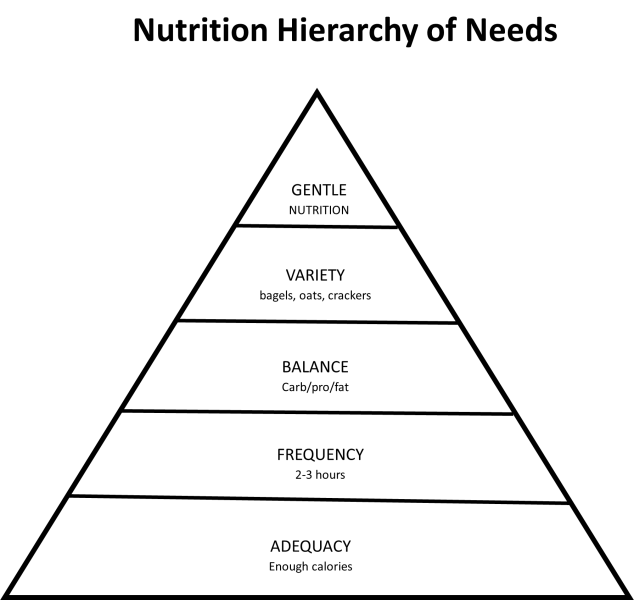
Well, let’s start with what I call the “the Nutrition Hierarchy of Needs.” Many of you might know of Maslow’s Hierarchy of Needs, which tells that we must fulfill our basic, lower levels before we have the capacity to fulfill the upper-levels.
We can apply this same concept to our nutritional needs—breaking down the needs that are vital to meet first. Instead, we often jump to the upper levels before having our very basic needs met.
If we first focus on our primary nutritional needs, we can more naturally and easily optimize our nutritional needs. Then we are better positioned to pursue and reach the upper-levels of the food hierarchy. It’s like climbing a ladder: if the first two rungs are broken, it’s very hard to get to the top.
Level 1: Adequacy
We must make sure we are consuming sufficient calories to give us enough energy. Most people assume they are consuming too much when really they are eating too little. Remember, “less” or “smaller” does not automatically equal health.
We must first ensure you are meeting your body’s average energy needs on a regular basis—if you’re not doing this, your body doesn’t care about, or benefit from, much else. Consider working with a registered dietitian who can help you figure out your estimated energy needs and energy intake.
Level 2: Frequency
Once you are eating an appropriate amount of food, you should consider when to eat. Most people prefer to eat every 2-3 hours if possible. This helps support normal blood glucose and metabolism levels. It keeps us from getting too hungry or too full.
We can’t always hit the timing perfectly because of our daily activities. But it is helpful to check in and see if you might benefit from eating more frequently.
Level 3: Balance
Next, consider eating a balance of food groups, meaning carbohydrates, protein, fat and fiber. A good goal is to include each food group at mealtimes and at least two at snack times.
When you are eating an adequate amount (level one … check!) and often enough (level two … check!), your body is poised to benefit from including a balance of nutrients.
Level 4: Variety
Eat a variety of foods within each food group. For example, if I only ate bagels for my source of carbohydrate, I would only get the nutrients found in bagels.
If I expand my carbohydrate options to include oats, crackers, sweet potatoes and others, I will get a wider variety of nutrients, as each carbohydrate source contains different types and amounts. When we have more variety, it is less likely that we will get too much or too little of any one nutrient.
Level 5: Gentle nutrition
This level comes when we have met all our lower-level needs over the long haul. At this point we might be ready to consider more advanced nutritional information or pay more attention to a specific nutrient without compromising our lower-level needs or our enjoyment from food.
For example, we might be looking for a cereal that is lower in sugar or a bread that is higher in fiber.
Jenni Wolf, a registered dietitian, writes about food and nutrition for the Bugle.
Photo cutlines:
Establish a solid nutritional base by meeting lower-level needs first. Submitted graphic by Jenni Wolf.
Make room for all the food groups on your dinner plate. Photo by Jenni Wolf.
