

By Kerry Morgan
My first educational foray into the world of de-icing chemicals was my son’s eighth-grade science fair project comparing the speed of four ice-melt products. Most of the details of that project have been lost, the cardboard trifold display recycled.
Over the years our family used up the granules in all the test containers. Sure, I noticed that the grass around our brick paths often died back and that our concrete patio showed signs of surface scaling.
But the real costs of our indiscriminate de-icer use would be lost on me for five years, until I got interested in the health of our waterways and became a Minnesota Water steward in 2023.
So, what’s the problem?
That certification program awakened me to issues that are largely invisible to us. For example, the degree to which surface and groundwater is polluted by urban runoff.
In St. Paul, when storm water and melting ice travel along impervious surfaces like sidewalks, driveways and roads into our storm sewers, it all ends up in the Mississippi River, untreated.
And I learned that road salt contaminates water irreversibly. Just one teaspoon of salt can permanently pollute five gallons of water. In Minnesota, the largest source of chloride pollution is the 445,000 tons of salt spread onto our roads each year.
What does that mean for our waterways?
According to the Minnesota Pollution Control Agency (MPCA), there were 68 water bodies impaired by excessive chloride in 2024, up 20% from just two years earlier.
Here’s what scientists also know: chloride kills freshwater plants and animals, harms pets, corrodes infrastructure and can impact drinking water quality.
Despite the branding and promotion of “safer” de-icing products, including those with formates in place of chlorides, none are safe. Even if the packaging says “Pet Safe” or “Eco Friendly,” all de-icers contain chemicals that harm our waters.
And there are no regulations requiring manufacturers to test before making these claims, said Lindsay Schwantes of the Capitol Region Watershed District in a recent talk hosted by the St. Anthony Park Community Council Environment Committee.
Some de-icers on the market include a logo that reads “Safer Choice: Meets U.S. EPA Safer Product Standards.” This federal program identifies criteria that make some products less problematic than others.
But recently the EPA announced that it would no longer certify any ice-melt products because of their overuse and their harm to infrastructure, the environment and pets. But we will see that little green logo for some time, since product manufacturers have until February 2027 to discontinue it.
What is being done and how can we help?
To encourage “smart salting” practices, the MPCA offers training for snowplow drivers and property maintenance supervisors. And they recently added a workshop for community leaders, including local government officials and people on environmental or housing boards.
If you are hiring help for snow removal, ask that they are “Smart Salt” certified. In addition to providing certification for highway and public/private applicators, the MPCA also offers a downloadable list of certified salt applicators. Use vendors that follow best practices.
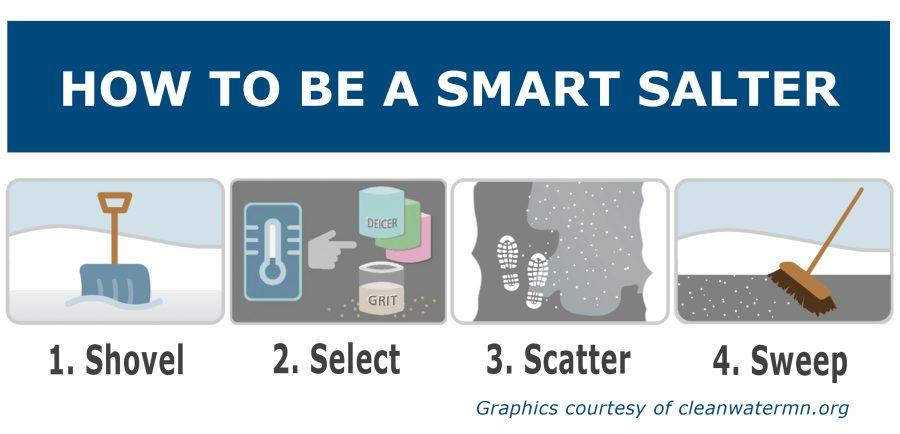
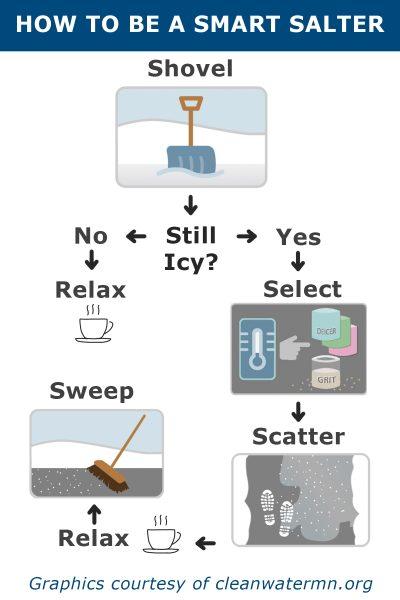
If you do your own snow removal, follow these four steps to minimize de-icer use:
1. Shovel early and often to stop snow from compacting.
2. Select the right product for the weather and temperature and use it sparingly. Do not use granular de-icers on bare pavement; apply only to ice. Check labels, as many de-icers do not work when pavement temperatures are below 15°F. Consider using a product like Cherry Stone grit, as it provides traction on top of ice, regardless of the temperature.
3. Scatter de-icing granules evenly, 1 to 3 inches apart. It’s true: more salt does not equal more melting.
4. Sweep up any leftover de-icers, grit and sand to save and reuse as needed.
I am doing my best to change my habits; I hope you might too.
Kerry Morgan is co-chair of the St. Anthony Park Community Council’s Environment Committee.