

By Dave Healy
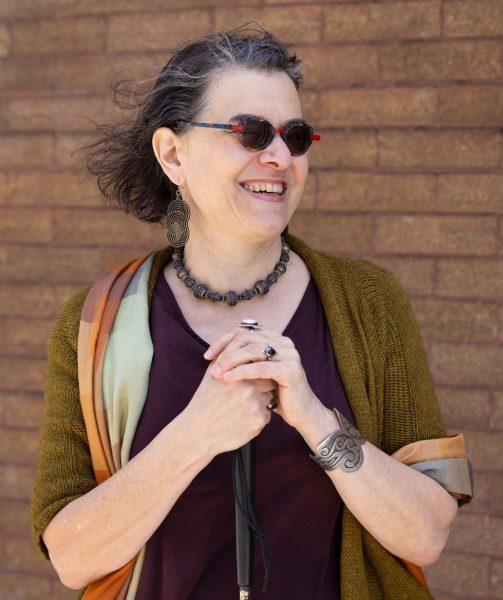
Naomi Cohn is legally blind, unable to read a print book, which is the primary format of “The Braille Encyclopedia” (Rose Metal Press, 2024).
“I still care about books as physical objects,” Cohn said, “and it pleases me when I hear about someone passing my book along to another reader. When I participated in the Twin Cities Book Festival, it was gratifying to see the number of people, including children, who come to an event that’s about print books.”
Cohn said her book will soon be available in other formats besides print through the Minnesota Braille and Talking Book Library.
Cohn has lived in St. Anthony Park since 1999. She likes being near the St. Anthony Park Coop, Hampden Park and public transportation. But what she likes most is the people.
“I’m in the city, but it feels like a village,” she said.
Cohn’s book was more than nine years in the making. It started as an essay about learning braille as a response to progressive vision loss, grew beyond that, and eventually assumed the format of an encyclopedia.
In an author’s note, she describes the 96 entries as brief essays, prose poems, lyric fragments, flash memoirs and vignettes.
Cohn was born sighted and until her early 30s functioned reasonably well with glasses. But a condition called pathological myopia led to a process called neovascularization and its resultant hemorrhages, which have been increasingly eroding her vision. She has limited depth perception and uses a white cane outdoors.
“I don’t pick up on facial expressions,” she said. “Social settings require more work than they used to. The more people in the room, the harder I have to work.”
Cohn has used various adaptive technologies over the years to read and write, but the one that changed how she feels about her disability and about herself is braille.
Learning braille is difficult, and although she’s been at it for 14 years, Cohn doesn’t consider herself an expert. She describes her reading speed as on the slow side. But learning braille has had unexpected advantages.
“Braille reconnected me to the wonder of being able to understand words,” she said. “It’s amazing what we do all the time without thinking about it.”
She said that the slower pace of reading braille fosters attentiveness and can have a calming influence.
Braille, a tactile system for reading and writing, was invented by Louis Braille, who was born sighted but accidently blinded himself using an awl in the workshop of his saddle-making father. He got the idea after hearing about a system invented by the military that used raised dots, which could be read in darkness.
In her book, describing her up-and-down love affair with braille, Cohn resorts to metaphor: “Braille is the ceiling of the Sistine Chapel, those almost touching hands of God and Adam. When my finger touches braille bumps, something moves inside me.”
“The Braille Encyclopedia” is available at rosemetalpress.com and at Next Chapter Books and Moon Palace Books. It can also be ordered through SubText Books and The Irreverent Bookworm.
Dave Healy lives in St, Anthony Park and is a former editor of the Park Bugle.