By Pat Thompson
What do sheep have to do with community solar arrays?
When Transition Town’s local investment group (LION) met last fall to hear about Cooperative Energy Futures, I thought I’d learn about how co-op members could invest in CEF’s latest solar gardens—those large arrays that generate electricity at community scale.
I did hear about that, and we can make those investments through July 2025.
What surprised me, however, was how much I learned about the ways community solar has changed in the past few years. That’s where the sheep come in.
Community solar for you and me
Community solar gardens are larger than home rooftop installations, but much smaller than what a utility would build to replace a power plant, like the one that Xcel recently opened in Becker.
Anyone who has an Xcel electric bill can subscribe to a community solar garden—whether you rent or own your home.
As Bryn Shank from CEF told us, “There’s no upfront cost to subscribe. No credit check is needed, or minimum income. For renters who pay their own electric bill, landlord permission is not needed.”
It’s for people who can’t have solar on their own rooftop or don’t have a rooftop they own, but still want to get their electricity from the sun. It can even be for people who do have solar panels on their roof, if they’re still paying substantial money for electricity to Xcel every month.
Subscribing saves money on your electricity costs, too, because the rate CEF charges is lower than Xcel’s. So anytime the solar garden is generating electricity subscribers save money.
Community solar today
The new things I learned at the November meeting were that community solar has become more accessible recently. Minnesotans who pay an Xcel bill can now subscribe to a solar garden anywhere in Minnesota, not just in our own county or an adjacent one.
Another change has to do with billing. Currently, subscribers get two separate bills, one from Xcel and one from their solar garden (which is less, and results in a credit at Xcel). Because of a recent change at the Minnesota legislature, Xcel will be required to offer consolidated billing for new solar gardens in 2025.
The legislature also implemented several consumer protections, including guaranteed savings for community solar subscribers, and no termination fees when withdrawing from a subscription.
Subscribe now
For a limited time CEF has spots available in its upcoming Lake Elmo solar garden, which is already under construction and expecting “energization” in early 2025. There’s priority registration for low- and moderate-income members.
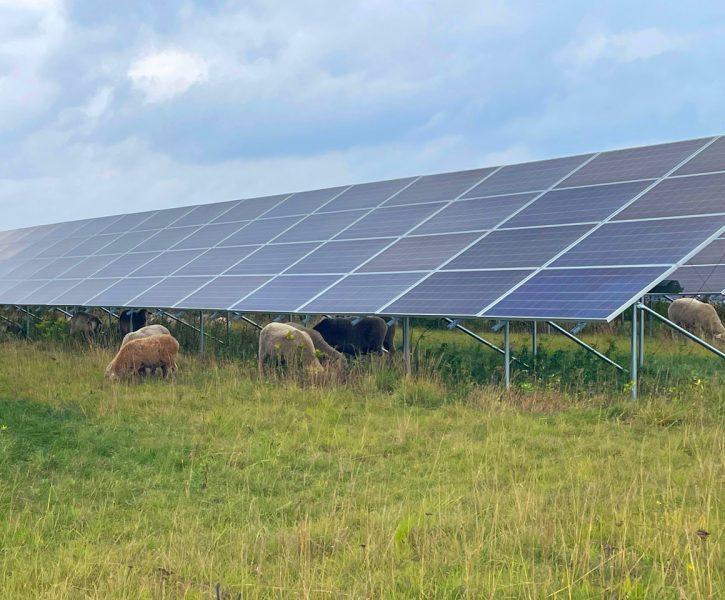
“The Lake Elmo garden lease payments will support the nearby Sally Manzara Interpretive Nature Center,” Shank said (sminc-lake-elmo.org). And the pollinator plants below the ground-mounted solar panels will be grazed by a flock of sheep brought in periodically.
To start the process of subscribing to Lake Elmo or another one of CEF’s solar gardens, such as Mankato or Midtown Minneapolis, you will need a copy of a recent Xcel bill for your house or apartment. It’s easy! Go to: cooperativeenergyfutures.com/subscribe. n
Pat Thompson is a member of Transition Town—All St. Anthony Park. She works on transportation, public gardening and local investing, among other community topics. For details on the next LION meeting, visit TransitionASAP.org/economy.
Photo: Sheep graze at Cooperative Energy Future’s solar garden in Faribault. Photo courtesy of CEF.
Collaboration Lab: two-part event
Transition Town—All St. Anthony Park hosts Collaboration Lab: Creating a Regenerative Community, a two-part event to tap into our collective wisdom and respond as a neighborhood to the ecological and social challenges of our time.
Two Saturday afternoons, 2 to 5 p.m. at Zvago Cooperative Living, 2265 W. Luther Place, with food provided by Mim’s Cafe.
• January 11: Brainstorming, using the Group Concept Mapping (GCM) framework (groupwisdom.com)
• February 8: Embarking, choosing short- and long-term projects for the neighborhood
RSVP for one or both on our Collaboration Lab page (TransitionASAP.org/collaboration-lab).
The Collaboration Lab is made possible by a grant from the St. Anthony Park Community Foundation.
Submitted by Mindy Keskinen of Transition Town-All St. Anthony Park.