
By Tracy Kugler
When it comes to climate action, what can we do together that we can’t do as individuals?
Answer: Encourage our group wisdom to emerge. We might find we are more powerful than we thought possible.
That’s why Transition Town – All St. Anthony Park is kicking off 2025 with “Collaboration Lab: Creating a Regenerative Community,” a pair of events on Jan. 11 and Feb. 8, designed to gather project ideas from the community and launch ideas into action.
Alone, the challenge of climate action may seem daunting or even futile. Together, we can pool our knowledge and skills, take on transformative projects and find joy in the process.
Projects to build a regenerative community
We’re seeking practical, neighborhood-scale projects to continue the transformation of St. Anthony Park and the surrounding area.
As we confront the global “polycrisis” of climate chaos, ecosystem destruction and the many injustices of extractive economic systems, we know we have to face these challenges together.
Rob Hopkins, founder of the Transition movement, put it this way: “If we wait for governments, it will be too late. If we act as individuals, it will be too little. But if we act as communities, it might just be enough, and it might just be in time.”
We invite you to think of projects that go beyond individuals and households, but that can be done within our neighborhoods without requiring major policy changes. Projects could address either mitigation (such as reducing emissions and protecting ecosystems) or building resilience for the changes we know are coming.
How can we build a neighborhood that nurtures better relationships with each other, with our more-than-human neighbors, and with broader social and ecological systems? How can we serve as a model for other neighborhoods?
Examples of some projects already underway in association with TT-ASAP include:
- Developing an online course for homeowners to phase out natural gas and electrify their homes.
- Fostering local businesses through a Local Investing Opportunity Network.
- Advocating for more eco-friendly uses of the land currently occupied by the University of Minnesota Les Bolstad Golf Course.
- Learning about greener end-of-life options together.
Group concept mapping
Thanks to a grant from the St. Anthony Park Community Foundation, the events will be structured using the Group Concept Mapping (GCM) framework developed by groupwisdom (https://groupwisdom.com). GCM is designed to gather ideas from a community, then organize the ideas and reflect them back to the community to help make decisions.
Much of Part 1: Brainstorming will be spent generating ideas in conversation with your neighbors. You’ll then sort the ideas into related groups and rate each idea on its urgency and its feasibility.
Between the January and February events, TT-ASAP volunteers will use GCM software to create visualizations, such as cluster maps identifying common themes and “go-zone” charts that display ideas based on how participants ranked them on urgency and feasibility.
In Part 2: Embarking, we will present the results and visualizations to participants. The group will use the information to select ideas for short- and long-term action. A key goal is to launch working groups around one or more ideas to move forward in 2025.
Join us!
Both events will be held in the community rooms at Zvago Cooperative Living, 2265 Luther Place, St. Paul, with food from Mim’s to fuel your thinking.
Part 1: Brainstorming, Saturday, Jan. 11, 2–5 p.m.
Part 2: Embarking, Saturday, Feb. 8, 2–5 p.m.
Feel free to come to either or both events. For now, put your thinking cap on and come with an idea or two to share. Or just show up with a willingness to collaborate for a better future in St. Anthony Park!
For details and registration, visit TransitionASAP.org/collaboration-lab.
Tracy Kugler lives in the Como Park neighborhood and loves trees, birds and maps. She is a research scientist in the Institute for Social Research and Data Innovation at the University of Minnesota.
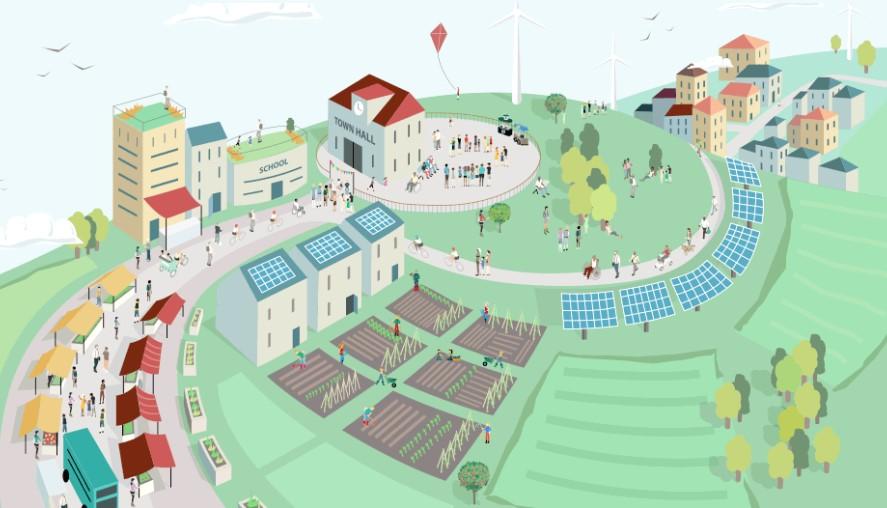
Photo cutline; What steps can we take now to move toward a just, resilient and climate-friendly community? Let’s work together to find out! Image source: Transition Network (https://transitionnetwork.org/).