


By Dave Healy
Some people, when seeing Scott Rykken’s loon pictures, might assume they’ve been Photoshopped.
“The first time I heard that, I wasn’t even sure what Photoshop was,” said Scott, a retired high school science teacher and amateur photographer. “I know a little more now, but I’ve never used it.”
The photos in question were taken at Lake Miltona in Minnesota’s Douglas County, where St. Anthony Park residents Scott and his wife, Anne, have a cabin. One attraction of spending time there is watching loons.
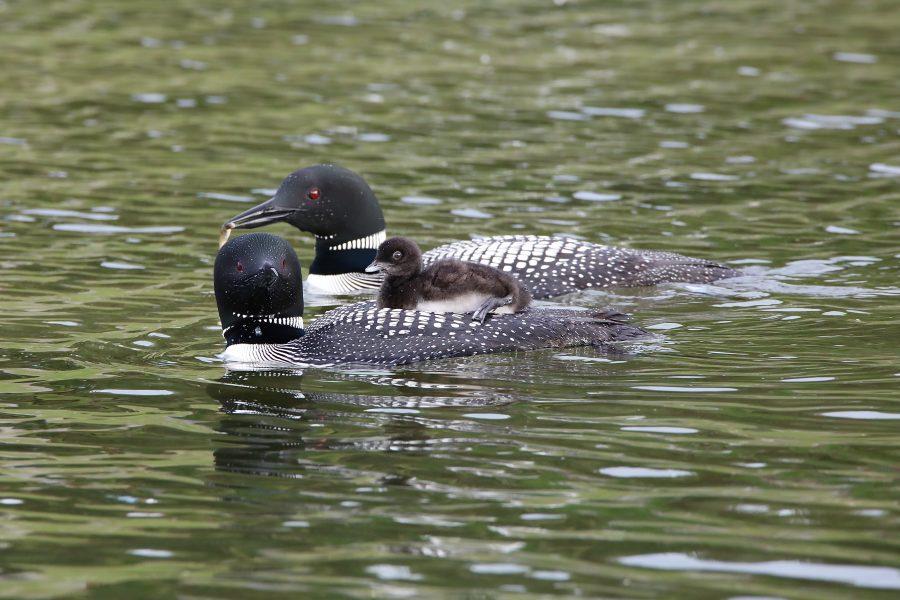
A pair of loons swim in Lake Miltona in Minnesota’s Douglas County with their chick. Photo by Scott Rykken.
In 2019, Anne heard about a neighbor who builds small rafts, using PVC pipe and chicken wire, suitable for nesting loons. She and Scott got one and set it out immediately after the ice was out on the lake.
To their delight, a female loon started using it right away. And because migrating loons usually return to the same lake, the Rykkens are pretty sure that “their” female loon is the same one that’s returned every year since then.
“Loons nest close to shore,” said Scott, “and their eggs are more vulnerable to land predators than if a nest can be built on a raft farther out in the water.”
Scott began taking photos of the nesting loon, which was joined on the raft first by basking turtles, then later by a muskrat, then two.
Usually the three species ignored each other, but one year he was amazed to watch a turtle climb onto the loon’s back. More amazingly, she appeared to help the turtle avoid sliding off by extending her wing.
A female loon is used to having something on her back, which is where she carries a chick.
“But there’s a big difference between a chick and a turtle,” Scott said.
Scott had been posting some of his pictures on a Facebook page: Loony for Loons. The photo of the turtle on the loon’s back captivated people’s interest, and Scott found himself besieged by requests for information and reprints by news outlets in the Midwest and beyond.
He began thinking that his photos, properly arranged, could lend themselves to a story, including imagined conversations among loon, muskrats and turtles.
He decided that the main character, the female loon, needed a name, and she became Lucy. Lucy’s new-found friends help her watch the two eggs and even oversee the second one’s hatching.
Anne added her graphic design skills to make a book prototype, and in 2021 “Once Upon a Loon” was published by MissionPointPress. It’s for sale online at Amazon and Barnes & Noble.
Many Minnesotans have never seen a loon. And none of us are likely to see what Scott and Anne have seen, but his amazing photos and charming story bring welcome attention to our state bird.
Dave Healy lives in St. Anthony Park and is a former Bugle editor.