

By Dave Healy
Doing your business in an outhouse. Carrying water in buckets from a well to meet your household’s needs.
Sounds like life on a farm.
But for Crystal Wisen it was life in Lauderdale — or what became Lauderdale in 1949. When she and her family moved there in 1936, it was Rose Hill.
The move was prompted by inexpensive land, and Crystal’s parents bought a plot and built their own house.
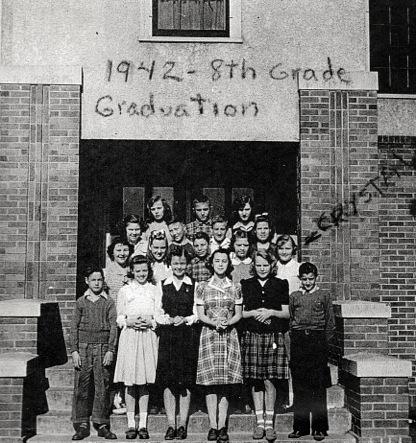
Bob Wisen also grew up in Lauderdale, and later he and Crystal married and settled there, after brief stints in Mora and Brainerd. Their five children went to Lauderdale School, just as Crystal and Bob had.
“Lauderdale was a wonderful place to raise kids,” Crystal said. “When City Hall was built and Lauderdale Park created, there were many community events that brought people together.”
After finishing eighth grade, Crystal went to Murray, graduating in 1946.
“There was no bus service,” she said, “so we walked to Murray, cutting through the U of M golf course and crossing the streetcar tracks. It was quite a hike, especially in winter, when we sometimes had to make our way through deep snow drifts.”
Crystal and her siblings and friends used the St. Anthony Park Library, and her parents shopped at Blomberg’s Grocery, the predecessor of today’s Speedy Market.
“Blomberg’s delivered,” Crystal said, “and you could call in your order and have it brought to your house. The store kept a book for each family, recording what they purchased and what they owed.”
Some Lauderdale landmarks are gone, including its water tower. Also, there used to be three bars on the corner of Eustis and Larpenteur. Crystal remembers that intersection as “a bit rowdy,” and some residents weren’t sad to see the bars replaced by other businesses.
Crystal and her family have always attended Peace Lutheran Church, which started in a house, moved to a clapboard building, and finally to its current brick building.
“Back then there was a Sunday School and confirmation classes,” she said. “Now the congregation is older, but the church still has many activities and does a lot of good in the community.”
Rose Hill never had its own streetcar or bus service. “If we wanted to go downtown St. Paul or Minneapolis, we walked down to Como and caught the bus,” Crystal said.
Lauderdale did have its own police force: a sheriff and constable. The city was also home to two dog-breeding kennels comprising opposite ends of the size spectrum: Russian Wolfhounds and Yorkshire Terriers.
“When there was a full moon, we could hear the Wolfhounds howling at the moon,” Crystal said. “But we went in for something much smaller and always had a Yorkie.”
“Bob’s sister is the only person I knew who played golf,” said Crystal, “but boys could caddy at Midland Hills and the U of M course. If they found balls that had strayed from the course, they’d set up shop with a bucket of used balls and pick up a little extra spending money.”
Housing has changed dramatically in Crystal’s years in Lauderdale. “It’s denser now,” she said, “and the houses are much larger than they used to be, and there are more apartments.”
Despite the changes — some welcomed and some regretted — Lauderdale has been a stable place for three generations of Wisens. Crystal’s daughter Linda Sventek and her husband, Steven, also a Lauderdale native, bought the family house from Crystal, who lives with them. The house is being remodeled, so for Crystal and her family, Lauderdale continues to represent both the old and the new.
Dave Healy lives in St. Anthony Park and is former editor of the Bugle.