

By Janet Pope
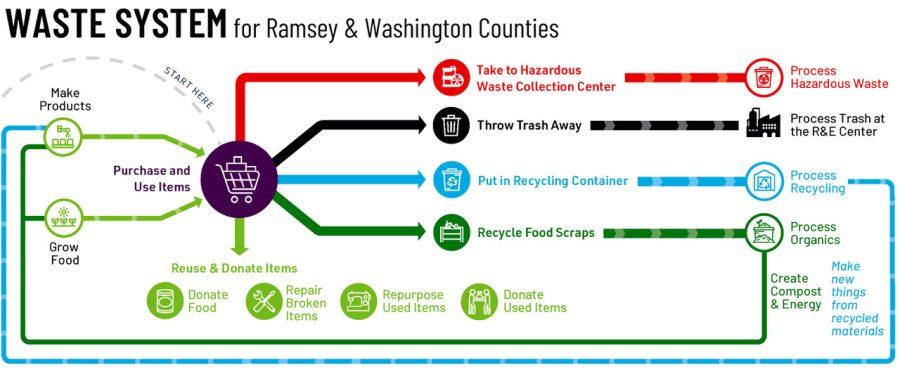
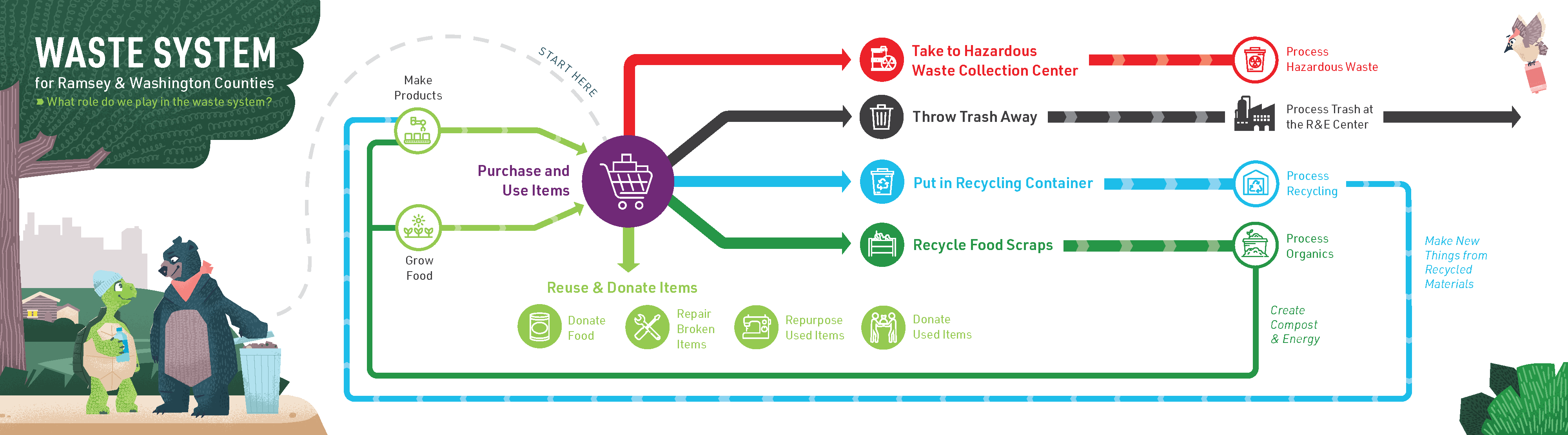
“Trash: every single person has an impact on it,” says Ramsey County board chair Victoria Reinhardt, “from what we buy, how and from where, how long we use it and what we do with it when it is no longer useful to us.”
How to deal with trash so energizes Trista Martinson that she stepped down as Ramsey County board chairperson on Aug. 1 to become the first executive director of Ramsey/Washington Recycling and Energy (R&E).
“When we interviewed Trista about the R&E job, she nailed every part of it,” Reinhardt reported.
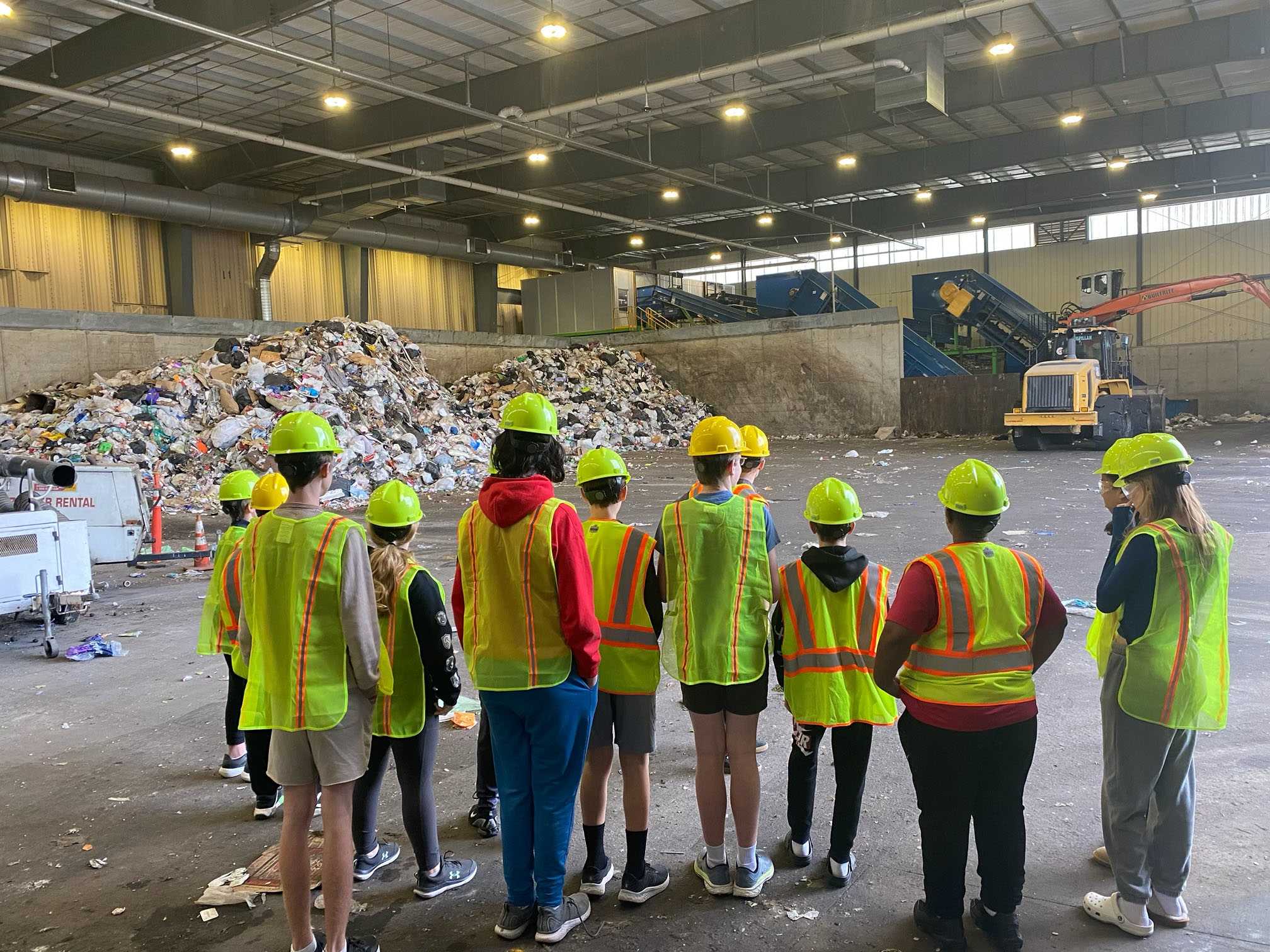
Martinson talked enthusiastically about R&E’s “upstream” efforts to decrease trash generated. R&E has multiple education efforts underway, including ways for households to generate less trash, trash-reducing technical assistance to businesses and public tours of the R&E Center located in Newport.
Recent Minnesota legislation will also help with recycling efforts, Martinson said. She cited the 2024 Packaging Waste and Cost Reduction Act, which will hold manufacturers accountable for their products and packaging through their lifecycle. It also requires all packaging in the state to be reusable, recyclable or compostable by 2032.
Working the whole trash stream
And then there are the ongoing and planned “downstream” measures to connect value to waste.
In 2016, R&E purchased its Newport center, where all solid waste from both Ramsey and Washington Counties is processed.
“I actually did not think we would end up buying it,” Reinhardt remembered. “But after extensive research and review, the purchase was made. Our goal was, and still is, to continually make improvements to gain value from our trash.”
About 400,000 tons of garbage is processed at the Center each year. Machinery sorts it, pulls out any recyclables and pulverizes the rest.
Of the resulting “refuse-derived fuel,” 87% is trucked for incineration to create electricity at two former coal-burning Xcel plants. The remaining 13% goes to Waste Management landfills in Burnsville or Elk River.
Forty tons of aluminum cans are pulled out of the R&E trash stream each week, or the equivalent of seven elephants. These are crushed, baled and sold for reuse. Mattress springs are also retrieved for recycling and resale.
Last year, the R&E Center added a new line that can capture plastics #1 and #2 for recycling. Once fully operational, it will allow separation of plastics for resale.
Martinson and R&E staff are quick to note that the recyclables, about one tenth of the trash received in Newport, are “dirty” recyclables because they have other refuse mixed in and therefore do not fetch as much on the resale market.
(Note: Recyclables sorted at home are sent elsewhere for processing. So are some other materials, including electronics and infectious waste.)
Organics pickup coming to St. Paul
Food scraps, on the other hand, are about 33 percent of trash received at the R&E Center.
After much planning, curbside pickup of food scraps has already been started in several suburban communities; the program will be rolled out in Saint Paul in the coming years. Households will be provided durable compostable bags to collect their food scraps and place them in their regular trash cart each week.
To follow the rollout plan, more information is available on the program website: https://foodscrapspickup.com/pages/phasing-plan.
“When fully operational, the R&E curbside pickup program in our two counties will be the largest in the country, possibly the world,” Reinhardt explained.
Currently, Ramsey County food waste is sent to a Mdewakanton Sioux Community-owned compost site in Shakopee. But R&E and a private partner plan to build an anaerobic digester where organic waste would decompose naturally in an enclosed space.
The resulting biogas and biochar can be used for renewable energy and soil improvements. These are some of the future developments that energize Martinson about her new position.
“The possibilities of using our trash to get renewable energy is pretty exciting,” she said. “This is my dream job. I get to be hyper-focused on challenges we have to address in the most equitable, environmentally responsible ways possible. I am ready to go!”
Janet Pope lives in the Como neighborhood. She’s an avid fan and supporter of community newspapers and local journalism.