

By Alex Bajcz
“An ounce of prevention is worth a pound of cure.”
— Benjamin Franklin
Environmental stewardship often focuses on preventing harm:
Controlling invasive species, for example, or influencing human behavior in ways that protect ecosystems. Although paid for upfront, prevention often costs less than mitigation in the long run.
Prevention efforts can be justified whenever we can demonstrate three things: first, that significant harms are likely to occur without prevention; second, that those harms actually can be prevented; and third, that managing or mitigating them would probably cost more than preventing them.
Of these requirements, surprisingly, it’s often hardest to demonstrate that harms are preventable. I don’t mean it’s hard to design prevention plans (though it can be). I mean it’s hard—maybe even impossible—to confirm that they work. How so?
Imagine proponents of a litter-prevention campaign are seeking renewed funding for public messaging, outdoor trash cans and so on, while detractors are arguing the costs exceed the benefits. Who’s right? In an ideal world, we’d let data tell us.
Here’s where things get complicated for the pro-prevention side, though. Consider:
- You can count litter you’ve found, but you can’t count litter that would’ve existed but now doesn’t—give a point to the detractors.
- You can’t be sure you’re not just overlooking a bunch of litter somewhere unless you search everywhere, which isn’t feasible—another point for the detractors.
- You can’t differentiate between litter found despite the prevention program versus because of it—a point to detractors again.
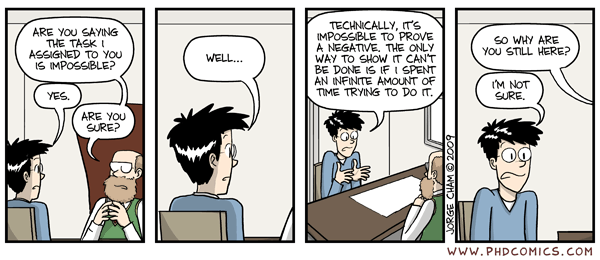
You can see the problem: Proving a prevention campaign is effective is trying to “prove the negative”—trying to show that something didn’t happen that otherwise would have.
Take a back-door approach
Lacking iron-clad data, how can prevention proponents support their argument? Environmental scientists employ a few common tactics:
Look for patterns in space/time. Imagine, post-campaign, littering has decreased 10% over the prior two years, and that similar reductions were seen in other cities with similar programs.
These are promising patterns, but opponents could rightly argue while they’re only consistent with effective prevention—they don’t prove it. How can we know littering slowed because of the campaign? What if it would have slowed either way? Correlation doesn’t imply causation. What if it was really because of a separate initiative, like a new aluminum deposit program?
Establishing cause and effect is often at least as hard as designing and implementing a prevention plan.
Simulate. If you can accurately simulate your system, you can generate simulated outcomes, with the campaign versus without it, and see how reality compares. But that’s a big “if!” Most systems are hyper-complex. Opponents can contend prevention didn’t actually do anything—the model’s assumptions were just wrong.
Agree on thresholds. Imagine we all agreed, up front, that a 10% litter reduction would be great but unlikely without an effective prevention campaign. If we then observed such a drop, we could agree the program must’ve been a factor, or, at least, it didn’t hurt. But did everyone really agree and help to shape this benchmark? Getting that level of engagement and buy-in is tough.
This exercise illustrates a key environmental concept that we don’t often teach: The only data that can prove prevention works are “counterfactual” data. Counterfactual means “impossible in our reality.” Once we’ve done anything, we can no longer ever know what would’ve happened if we hadn’t done that thing—that alternative, “control” reality is gone.
In this way, a climate-change-less world is counterfactual. So is a PFAS-less world, an invasive-species-less world, and a COVID-less world. Everywhere we turn, we face harms we might want to prevent, but we cannot procure definitive data to defend that prevention work.
Acknowledge the uncertainty and act anyway
Whenever prevention is debated, we should ask: Are we placing the burden of proof on the preventers? If so, is that burden too great?
As citizens and stewards, then, we must choose among three futures, ones in which we don’t practice prevention because we can’t prove it works; one in which we endlessly argue about whether all the prevention we are doing is justified; or one in which all agree on what kind of evidence in prevention’s favor we would accept.
We’ll never know what would have happened in the two futures we don’t choose, but I’m nonetheless confident that the third is preferable. Prevention’s success is uncertain, but by now, we know the harms of failing to protect our environment are existential. Between the two, inaction is the greater risk.
Alex Bajcz is the quantitative ecologist for the University of Minnesota’s Aquatic Invasive Species Research Center. He serves on the St. Anthony Park Community Council’s Environment Committee.