

It was time for me to have one of those full bitewing dental X-rays — ho hum, a standard dental practice I have long experienced over the years.
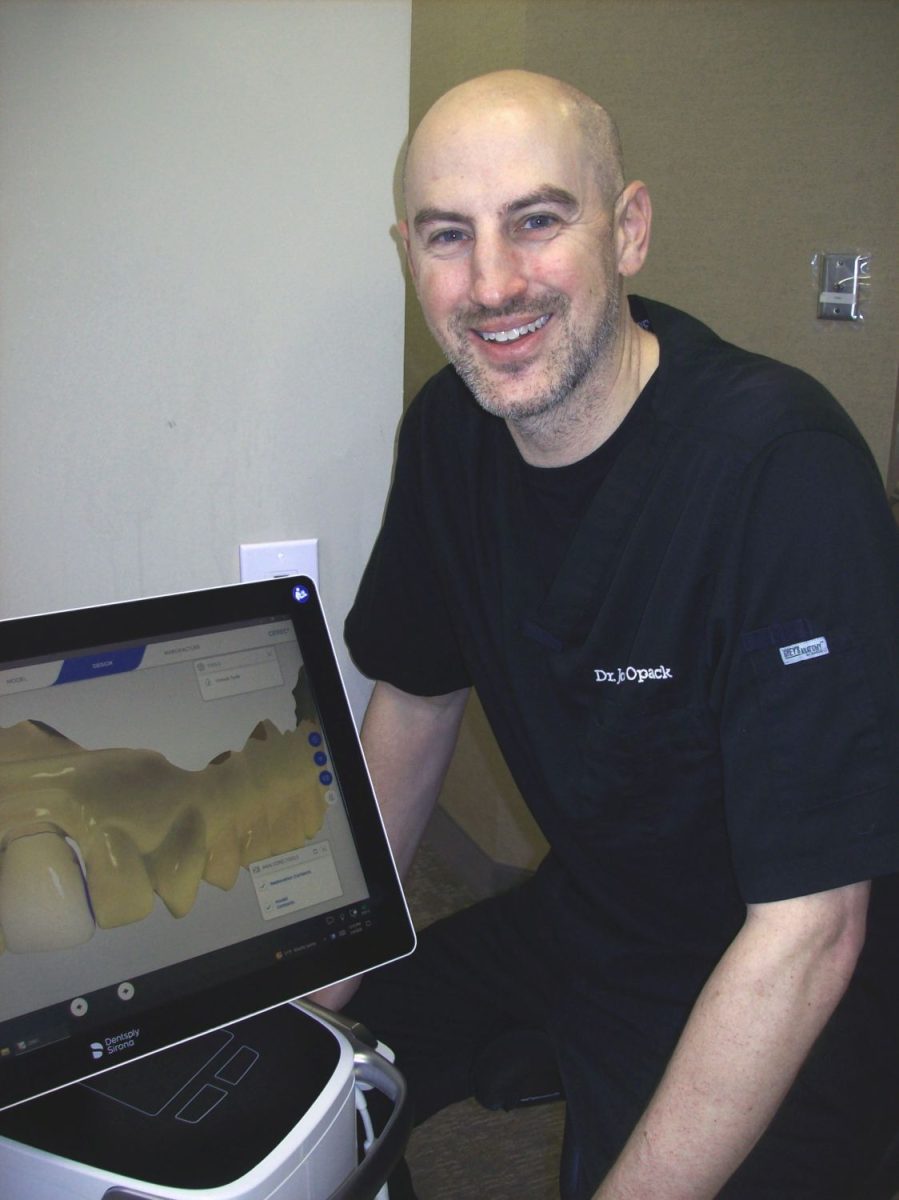
But before you could say razzle-dazzle, the dental hygienist on my recent visit directed my attention to a large computer-screen-sized, full color, 3-D, AI-assisted digital rendering of my teeth.
It turns out that AI (artificial intelligence) has entered the world of dental X-rays.
Not only was I seeing a colorful and highly visible digitally-produced image of my teeth, the AI tool had vividly indicated places that may require attention now or possibly in the future — prognosis predictions that also gauge the severity.
While AI’s emergence into dentistry may not have been as news worthy as its ever-expanding role in education or industry, it has been transformative. At least, that’s the word that has frequently appeared in dental peer review journals over the past couple of years.
However, when “transformative” went from scholarly journals into a Forbes business magazine headline, “How AI is transforming dentistry from diagnosis to payment” (July 9, 2025) — it was time for a Park Bugle chat with Dr. Joseph Opack at St. Paul Family Dentistry.
Because this clinic, near the intersection of Lexington and Larpenteur avenues, has two dentists with the last name Opack — Joseph and David — Dr. Joe will be used to avoid confusion. Dr. Peter Stanton rounds out the trio of dentists there.
I arrived at my recent appointment wondering how does AI’s analytical role fit into the hands-on professional skills of a dental clinic, and where else, beyond digital X-rays, it is showing up?
As Forbes notes, the global AI dentistry market was valued at $421 million in 2024 and is projected to reach $3.1 billion by 2034. That translates to 636% growth in 10 years.
But while AI’s impact on dentistry may be transformative, it is not taking over, assured Dr. Joe. Instead, he said, AI serves as an added tool for the dentist and clinical personnel.
AI a second dental opinion
Consider dental AI as an instant second opinion or a skill enhancer, Dr. Joe suggested. It contributes to, but does not replace, clinical experience, expertise and judgment. Nor, as he emphasized, does it supplant a clinic’s dentists, hygienists, dental assistants and front desk personnel’s invaluable human interconnection with patients.
Dr. Joe noted, for example, while the AI tool for dental X-rays is trained on “something like 60 million x-rays, it is not perfect. But it is a tool that learns.”
Thus, if any of the clinic dentists see that the AI tool missed something or they don’t agree with the AI interpretation, they hit the misdiagnose button. Their AI software learns from that.
So, there’s far more going on with dental technology and innovation than the AI razzamatazz of my digital X-ray. Different dental offices, different rates of usage. Here are some additional examples from this Como neighborhood dental clinic:
- AI-assisted diagnosis, treatment planning and production, including same-day crowns and implant surgery.
- Dental product: Curodont. When a very tiny cavity or crack is discovered (maybe via that digital X-ray), this brush-applied gel on the tooth’s surface uses one’s own saliva to arrest the cavity’s progression and rebuild the tooth enamel. No drilling necessary!
- Ergonomics: Declination angled loupe. In contrast to the typical awkward postures that teeth cleaning requires, hygienists using this loupe sit up straight and appear to be looking into space (in contrast to leaning over and looking directly into a patient’s mouth). It’s about quality patient care and career longevity, as its use reduces the strain on the hygienist’s back and neck.
Two-way benefits
Dr. Joe credited Dr. David Opack for championing the technological advance of digital X-rays at their clinic. While the clinical team’s focus is on the detailed information provided on teeth, gums and bones, patients appreciate its vivid and easily seen outcomes.
“Patients can clearly see what we see,” Dr. Joe said. They no longer need to struggle to figure out what’s being interpreted based on the small, hard-to-decipher black-and-white images of the past.
Cavity, heal thyself
Have you ever heard the expression “watch-area,” as an alert for potential cavity development? Dentist clinics of today can do more than just wait and track.
Dr. Joe is excited about Curodont, a brush-applied gel product that originated from the Swiss company vVARDIS, becoming available in the United State only in late 2024.
“Cavities start as a small hole,” Dr. Joe said. “If it is caught early enough, a tiny crack detected by AI analysis, for example, we can etch the area and apply a solution of Curodont. No drilling.”
A cavity repaired without drilling? This sounds like something out of TV’s “Jetsons.”
It gets even more futuristic when Dr. Joe explained that “Curodent attracts minerals (calcium and phosphate) from a person’s own saliva to arrest a cavity’s progression and rebuild the tooth enamel.”
It’s also low-risk. “Research,” he adds, “shows a 90 % success rating and there are no side effects with reasonably good follow-up home care.”
If the Curodont procedure fails, a traditional cavity filling process is the fallback.
The University of Minnesota’s School of Dentistry website highlights that it is leading the way with digital dentistry throughout its curriculum and in its Continuing Dental Education and mini-residency offerings. AI supports students’ work both in simulation and clinical environments.
Kathy Henderson lives in St. Paul and is a regular writer for the Bugle.
