

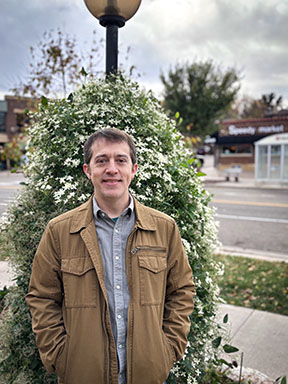
Steve Parshley is one of those kind and quiet neighbors whose humility hides the fact that he’s engaged in extraordinary work.
A resident of St. Anthony Park with his wife and a kindergartner, Parshley is a full-time, remote project engineer at Cornell University. For over 10 years he has been managing the unique design and construction of a novel telescope in the Atacama Desert of Chile.
Parshley explained the instrument’s extraordinary qualities include “a design that hasn’t been done before. It feels very exciting.”
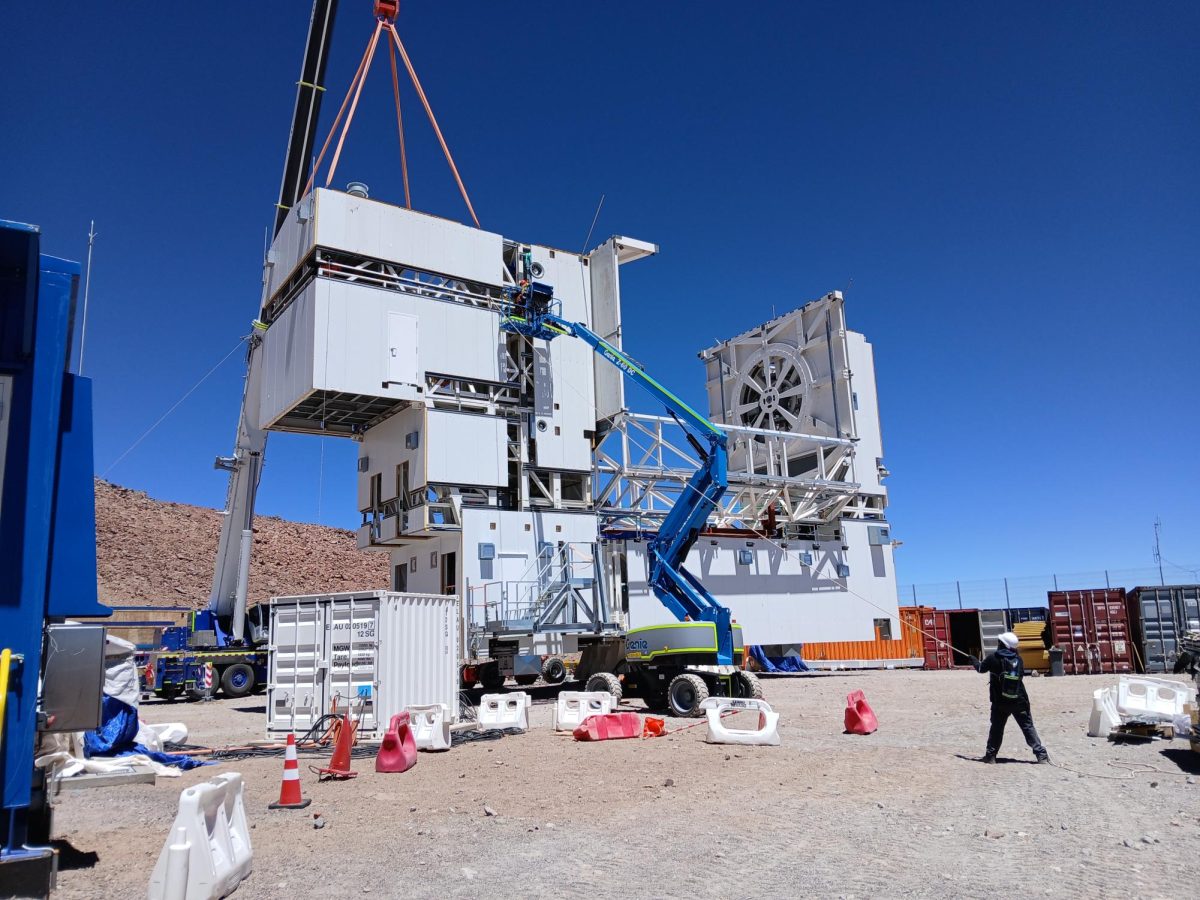
While the CCAT Observatory’s telescope isn’t the largest or most powerful, it is currently unparalleled. (Originally standing for Cornell-Caltech Atacama Telescope, the acronym CCAT is now inconsequential, but has stuck.)
The telescope at CCAT has its own name, the Fred Young Submillimeter Telescope, named in honor of a Cornell alum and substantial funder of the CCAT project.
“It is fair to say that the project wouldn’t exist without him,” Parshley said. The telescope is a 6 meter (20 foot) in diameter survey telescope. “It has a relatively large field of view as opposed to a classic telescope, so we’ll be able to survey the sky with better resolution and better sensitivity, at a wavelength that hasn’t been mapped before,” Parshley expanded. “Think far, far infrared wavelengths.”
Currently, the CCAT observatory is being built in the mountains east of San Pedro, Chile. The site is considered exceptional for a telescope because both the high elevation and low humidity of the desert decrease sight-obscuring air humidity.
“We’ll be able to look across more of the sky than has happened before,” Parshley added. “That’s all exciting because whenever you look into the unknown, you always find new things, throughout all of science history.”
Growing up in New Hampshire
Looking into the unknown has always appealed to Parshley, who grew up in a small New Hampshire town.
“As a kid I wasn’t into sports, but I was taking my toys apart and dreaming of the next fort that I wanted to build,” he remembered.
Parshley added that NASA’s space program had a big impact on his early days as did PBS’s NOVA series.
Parshley also credited his family for stirring his interest in engineering. “My dad is very handy electrically, and my uncles were farmers, therefore, natural tinkerers when I was growing up. From a pretty young age I was drawn to technology. In high school I was interested in the engineering path.”
Parshley credited a particular class at his public high school with inspiring his career path.
“The class was called Principals of Technology and it was a blend of physics theory where we also got to build models,” he explained.
“I realized in that class that I wanted to be the guy who designs machines and instruments.”
Starting college
In 1993, Parshley began attending Ithaca College (Ithaca, NY), enrolling in their 3–2 program, which consisted of three years of physics at Ithaca College followed by two years of engineering at an engineering school. (Parshley attended nearby Cornell University, earning two bachelor degrees, one from each institution, over five years.)
After graduating, Parshley worked in industry for a while; first for Boeing, then with a friend at a start-up company (which ultimately didn’t succeed), then as a consultant for a small engineering design firm.
Eventually, Parshley returned to Cornell University as a full-time employee where he simultaneously earned his master’s degree in engineering in 2009.
Also upon returning to Cornell, Parshley met his wife, Susan Rottschaefer, while both were university employees; he in the astronomy department and she in entomology. They were together for eight years before moving to the Twin Cities metro, where Rottschaefer is from originally.
Back to telescope building
Parshley recalled CCAT’s genesis. “Cornell’s history with this project goes back at least 25 years,” he said. “Back then there was a professor who would rent a truck, drive up into the mountains and conduct site surveys for some future telescope.”
The original plan was to build a huge 25-meter telescope, but after an initial partner left the project, Cornell decided it didn’t want to let the opportunity slip away.
Parshley explained, “We knew we had an amazing site, and decided to put in a Pathfinder telescope — something small, something we could afford — and that morphed into the current project that we have now.”
On the day the Bugle interviewed Parshley, he said his German-made telescope’s mirrors were in the middle of their two-day trek from San Pedro to the summit of the observatory.
“They are the last pieces of the telescope to arrive,” Parshley said. “Everything else was already up there. We hope to have first light in mid-2026.” The term “first light” is what astronomers call the first observations with a new telescope.
Besides extremely expensive mirrors making perilous treks over snowy, Andean Mountain passes, Parshley and his team have overcome numerous challenges in building the telescope. Besides technical problems, funding issues and scheduling conflicts, the most eye-opening challenge for Parshley has been communication.
“We have collaborators in the U.S., Canada and Germany; workers in Chile; and one of the sub-contractors is in the Netherlands. There are at least three languages present in our work at any time. It really has made me appreciate people who have great communication skills.”
Once the telescope is operating, Parshley said it will be tightly managed.
“There will be a whole slew of people who will work on the science and the scheduling and all of that. It’s not the type of telescope that others can apply for time to use, or at least, we don’t envision that as of yet.”
“Hopefully the telescope will run remotely,” he continued. “We’ll need to go there occasionally for maintenance updates and checks, but it’s not going to require anyone to be physically present for normal operation.”
Parshley said a remote astronomer will be on duty to respond to warnings or errors and escalate issues as needed.
Even so, the telescope and its many systems will require a once-a-week in-person visit from local Chilean staff members, some of whom commute from Santiago.
“We’ll need someone to go there weekly, physically, to flick the gages, open the doors, turn on the lights, and troubleshoot any issues,” Parshley said. Once CCAT is operating, Parshley will continue to work with the project.
“It’ll be so interesting to see how the design works.”
Asked if he dreams about CCAT revealing any new specific aspects of space or astronomy, Parshley said he expects the telescope will be used to explore a wide range of science, from star formation within our own Milky Way galaxy to new aspects of the cosmic microwave background (leftover traces of the Big Bang). That includes the Epoch of Re-ionization, a specific time-range immediately following the Big Bang when chemical elements became capable of forming galaxies.
Parshley said of the Epoch of Re-ionization, “It’s a hot topic right now, a lot of projects are looking at stuff from that era.”
Parshley noted that astronomy has been understood historically via snapshots, but the whole field is on the cusp of moving into video.
“That’s going to open up all sorts of new science,” Parshley said. “Because CCAT is going to survey a lot of the sky, pretty frequently, if something out there is moving and we can detect it, we’re going to see it. That’s the thing I’m most excited about, to see what the transient surveys pull up.”
In the meantime, as Parshley waits for his telescope’s first light, he is teaching his kindergartner the names of planets, and relaxing by reading books or playing the bass guitar, anything from Red Hot Chili Peppers to Stevie Wonder.
And while he spends a good deal of time in New York and Chile for work, Parshley is glad St. Anthony Park is his new home town.
“I’m an outsider who moved here and I feel really lucky that we ended up here by chance. It’s a great community.”
Sarah CR Clark lives in St. Anthony Park and is a regular freelance writer for the Bugle.
