

By Nancy and Bill Lorimer
The country of Turkey was the destination of 31 travelers from two St. Paul Lutheran churches, St. Anthony Park and Gustavus Adolphus, in a pilgrimage to the sites of seven churches addressed in the Biblical book of Revelation.
These seven were among the earliest Christian churches founded by the apostle St. Paul and his followers in the first century. Along the way, our travel group was introduced to other important Hellenistic and Roman sites and monuments.
Background of Turkey
Turkey is a Muslim country, evidenced in the head coverings of many local women and the prevalence of mosques and minaret towers piercing the sky above the cities. And heard … by the chanting of the muezzins whose calls to prayer chime across the cities five times a day.
We flew into Istanbul, a huge city of 16 million people, remarkably clean (no trash or litter seen anywhere), with very heavy traffic that our coach driver managed expertly.
While walking about, even in crowded places, we felt safe, even without an obvious police presence. We noticed that people even left the myriad parked bicycles and scooters unlocked. Sections are named for the many villages incorporated as this great city spreads ever outwards.
Given a long history of bazaars, shopping is still generally organized by area and product. For example, at one point we rode through several city blocks with three story facades parading mannequins in white fabric confections … the wedding dress market.
The old town’s famous monuments — the Hagia Sophia, the Topkapi Palace, and the Blue Mosque — were by far the most crowded of all the sites we visited. Not just by people but also by the cats that roamed everywhere in this and other cities, not just tolerated, but obviously celebrated in Turkish culture.
In the Hagia Sophia, once a Christian church and now a mosque, we were not allowed on the lower level. We could only look over the balcony to get a real sense of the vast interior space.
The Topkapi Palace is similar to a Chinese palace with buildings serving specific functions, like the Sultan’s private residence, his hall of audience, a training school for elite boys, and the massive kitchens, each set in a pavilion with patterned lawns, time-sculpted trees and beautiful flowers.
The extensive verandas offered stunning views of three legendary bodies of water: the Golden Horn, the Bosporus and the Sea of Marmara.
A look at waterways
We enjoyed a closer look at these waterways when we boarded a boat on the Bosporus. This narrow channel to the Black Sea is heavily trafficked with some 130 boats passing through each day. Cafe patios, university buildings, bustling streets and a “new” royal palace that dates from the mid-nineteenth century line one side, with elegant country estates and verdant wooded areas gracing the opposite bank.
Leaving Istanbul in our comfortable coach, we drove west then south down the Aegean Sea, first crossing the Dardanelles, remembered for an Allied defeat early in WWI.
In the Turkish countryside, we passed rich agricultural fields of lemon and orange groves, grape vines, olive trees, sunflowers and myriad small factories producing consumer goods like cotton fabric, olive oil, clothing and auto parts.
Many sustainable energy projects were evident, with wind turbines on hilltops, large solar panel fields on south-facing slopes and massive steam plants taking advantage of near subsurface heat in this geologically active region.
Historic sites
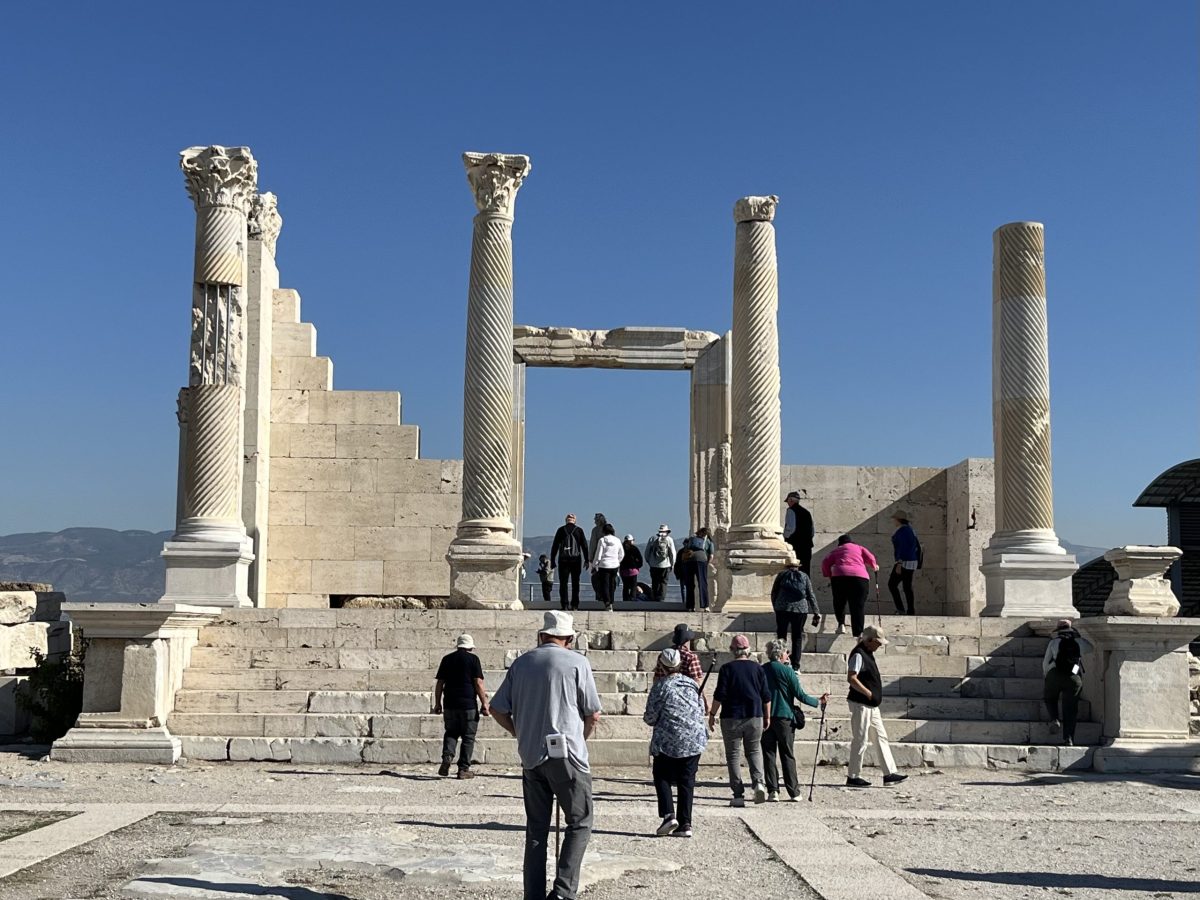
The scope of historic excavations we visited ranged from the very extensive (Sardis and Ephesus) to the size of a single city block (Philadelphia), where a bustling city, Alaşehir, sits atop the ancient, scarcely excavated site. We sensed that you could dig nearly anywhere in this region and discover either Hellenistic (early Greek) or Roman ruins.
Elsewhere we walked (and walked!) in fields of broken columns, past half-walls and extensive necropolises, up and down rubble-strewn hills to see temples, mosques and churches, often excavated and partially reconstructed. Harvard and Cornell universities were involved in several earlier projects, but now it seems Turkish institutions are seizing the initiative.
Tour guide Cemil
Our exceptional guide, Cemil Bezmen, an Oxford-educated social anthropologist, explained how Greek shrines became Roman temples that became Christian churches that are now mosques. A dean among Turkish guides, his broad range of knowledge led us through the centuries.
Our accommodations were excellent, from the Hotel Armada, only a 10-minute uphill walk to Istanbul’s main attractions, to the Hotel Charisma in Kusadasi, a cruise ship port near Ephesus, where we enjoyed tangerine sunsets from balconies overlooking the Aegean Sea. Meals included extravagant buffets with honey-soaked desserts.
Time for fun
There was time for fun, too.
In Pamukkale, the more intrepid members of our group opted for viewing the stunning white travertine terraces, formed from mineral springs, by paragliding and hot air ballooning above. Two of our hotels had thermal pools and spas that offered Turkish baths and massages.
During a rest on the heights of an amphitheater in Ephesus, our three pastors braved steep stairs for a Frisbee toss-around in the arena where ancient Romans once raced chariots.
In a parting ceremony, our group presented this same Frisbee to Cemil as a light-hearted thanks for his excellent guiding, for helping us see ourselves in the fragments of other times and for exposing a small band of Minnesotans to Turkey’s astounding richness.


Nancy and Bill Lorimer are members of St. Anthony Park Lutheran Church and residents of the Zvago SAP Cooperative.