

On the past, present and future of Breck Woods
By Eliza Swedenborg
Recently, I hosted a group of community members for a small time- travel experiment to explore the future of Breck Woods.
We were just under a dozen people, gathering for a few hours, equipped with our own memories and imaginations, and teamed up with the living Woods themselves.
A look back
Before rushing forward, we took a gentle reunion tour through years past, first to the buzzing wetland back before European settlers arrived at this small nook of Turtle Island. Then to the laughter and wonder and likely mischief of Breck School students wandering from their brand new campus buildings into the Woods a full century back.
We followed into the quiet contemplation of Luther Seminary students on their walking commute between homes on Eustis Street and the campus. And finally to our own memories—owls, bug bites, fallen trees and forts; a mink, a sandpiper, a splash-down in the pond; and an irresistible invitation to explore as if accompanied by Piglet and Pooh (“As soon as I saw you, I knew an adventure was going to happen”).
It was a quick tour, but truly a rich one. We could have stayed longer, but our itinerary led us onward.
Now to the future
So, to the future we went. This time, slower. Quietly sensing into what could be.
We imagined the Breck Woods of the future infused with more life. It was more accessible to all members of the community, and it was reaching and strengthening more hearts, bodies and minds. All while retaining the Woods’ spirit: sacred, untamed. And all in the realm of the possible.
“The future enters us in just this way, to transform itself within us long before it happens.” — Rainer Maria Rilke
I didn’t expect the pain I felt at “re-entry.” Of coming home to the present time, to the reality and speed of decisions being made about the Woods now.
But after our little experimental time travel journey to the future, we looked again to the most recent plans for the Woods’ development. The latest available concept from the developer—as of a Sept. 23 presentation to Lauderdale City Council—showed a 68-unit cooperative building penetrating through the middle of the Woods, from Hoyt down toward the Woods’ pond, disturbing at least 2.5 acres and dissecting the remnants. It was crushing.
I am looking forward to adding many new neighbors to this community. Apartments, condos, senior housing: Yes, yes, and yes.
AND development doesn’t need to happen in the middle of Breck Woods.
Surely we collectively—the community, developers, our city government officials and Luther Seminary—are clever enough to figure out how to shift much of the development out of the Woods, and conserve and revitalize the Woods remaining?
Surely we are patient enough to let exciting and creative and collaborative ways forward emerge?
Surely we can figure out how to work toward a shared vision of the future, rather than work against competing interests?
I hope that by the time this commentary comes to print my concerns (some of them, anyway) are resolved. But I cannot actually see the future. So just in case, here I am.
This workshop was part of the “Postcards from the Future,” a project to explore what our collective imagination holds for the future of land in transition in our community due to the sale of the Luther Seminary campus (including Breck Woods) and the University of Minnesota’s Les Bolstad Golf Course.
The project is supported by Transition Town–All St. Anthony Park and Friends of Breck Woods.
To learn more, save the date for Thursday, Jan. 8, for the St. Anthony Park Branch Library forum, and mark your calendars to visit our exhibit at boréal Gifts & Goods during the month of March.
Eliza Swedenborg is a board member of Friends of Breck Woods and a member of Transition Town–All St. Anthony Park.
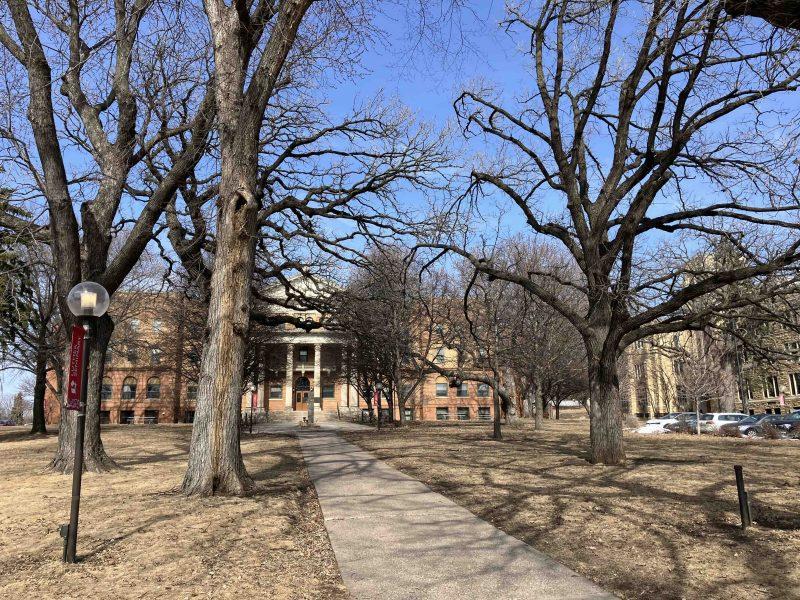
Photo cutline: What will the life of the Breck Woods be after Luther Seminary sells its long-time campus home off Como Avenue in St. Anthony Park? It is one question to be considered in workshop called “Postcards from the Future,” a project explore what our collective imagination holds for the future of land in transition in the SAP community. Photo by Janet Wight.