

What’s ahead for Luther Seminary campus and the University of Minnesota Golf Course?
By Eliza L. Swedenborg and Ann Juergens
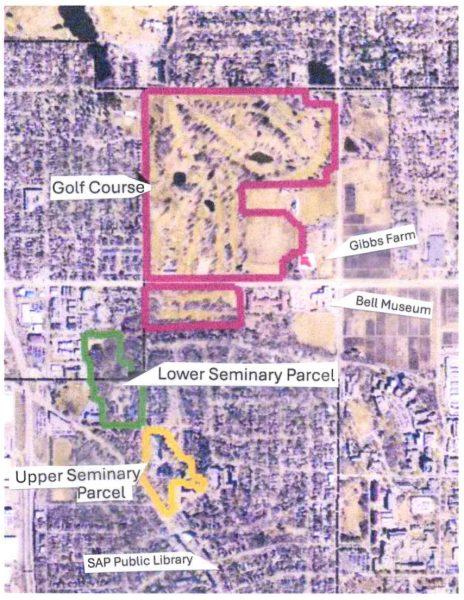
A huge swath of land in our neighborhoods — nearly 167 acres — is for sale or under contract for development.
Luther Seminary and the University of Minnesota hold title to those lands, seeking to sell the bundle of rights that is “land title” to purchasers who almost certainly will not be public entities.
A key question for sellers, officials, new owners and the community is: How much of this precious land will remain available for the public’s continued use?
The future of these lands demands reflection on their not-so-distant past. The ground that holds the golf course and the seminary is the traditional homeland of the Dakota people. The Dakota, like many Indigenous peoples, consider the earth a living entity. No person can claim “ownership.”
Yet with settlement, mostly white, European-American migrants brought a new concept: private land ownership. In this region, land rights and access were wrested from the Dakota through two treaties in 1851 that promised the Dakota pennies per acre — much of it never paid — and declared the land open for privatized white settlement.
Land titles were transferred to Luther Seminary and the university not long after. The university was founded in 1851 and opened its St. Paul campus golf course in 1916. Luther Seminary was founded in 1869 and moved to its home in St. Paul in 1900.
Though privately and semi-privately (in the case of the university) held, the lands of both have enjoyed significant public access. This public habit of entry can perhaps be attributed to the nature of the two institutions. The university’s land grant charter and the seminary’s stated Lutheran mission — on top of its property tax exemptions that are rooted in legislative recognition of these missions — have meant that each school has a duty to the public good. They have been living up to that duty for more than a century.
Today, we walk, play and gather on the seminary and university lands. Anyone can then amble the university’s trolley track trail all the way to the golf course. The public plays golf on that course and many of us run and ski on it.
Nonhuman creatures follow these same paths, and migrating birds rely on the many trees in these green spaces. We enjoy chance encounters of reconnection with neighbors old and new, we anticipate spring’s first jack-in-the-pulpit and we find solace in the company of warblers.
Importance of public commons
The importance of public commons to a healthy society is evident. In the context of the loneliness epidemic, political polarization and declining mental health, public commons can provide spaces for people to reconnect with each other and the natural world. They are a buffer and a boon for public health, community culture and resilience.
Private buyers of these lands will owe no specific legal duty to the public other than to follow building and watershed regulations. The city of Falcon Heights, Ramsey County and the state has each declined to purchase the golf course land.
So, what public life is on the horizon for these soon-to-be privatized lands? Will future developers and landowners design and maintain public access and use of the land? And if so, how?
Granting “easements”?
One potential tool for “commoning” private land is a grant of easements.
Public access easements secure a right for the public to use an identified portion of private property for specific purposes, such as access for pathways and playgrounds.
Conservation easements permanently restrict certain types of development on an owner’s land to preserve its conservation value. Public access is only guaranteed when it is specifically written into the easement agreement.
Both types of easements are attached perpetually to the land, not to individuals, and remain in place when the land is sold or inherited. Such easements that “run with the land” are held and enforced by an entity, such as a conservation organization, neighboring owner or government body that is separate from the owner whose land is affected.
Easements can also be a legal tool for restoring access and cultural rights to Indigenous communities, as a step toward making amends for historical wrongs.
Creating easements is voluntary. Public access will not be protected unless local officials and developers step up to that challenge. Developments whose grounds and roads are entirely on private land, as the development plan for the seminary lower campus is proposed to be, can morph over time into gated communities unless the developer agrees to public use conditions that attach to the land itself.
This is a complex and historic opportunity for our communities to exercise their best civic engagement muscles. One way to do that will be to attend forums hosted by our local officials and developers to gather community input.
The St. Anthony Park Community Council Seminary Task Force is planning a public meeting in early to mid-November with Lifestyle Communities Inc., the developer with a purchase agreement for the lower seminary campus. Look for the date on the community listserv or at the SAPCC District 12 website.
Mark your calendars for Thursday, Jan. 8, and plan to attend the St. Anthony Park Branch Library Association Forum (6:30–7:30 p.m.) to learn about — and engage in — “Postcards from the Future,” a community art and dialogue project supported by Friends of Breck Woods and Transition Town–All St. Anthony Park.
Let’s roll up our sleeves and get creative! As transactions unfold, let’s show up to ensure that the sellers, the new owners and our elected officials are mindful of this land’s longstanding contribution to the public good and our need for that to continue.
Ann Juergens is director of Friends of Breck Woods and a resident of Zvago SAP Cooperative. Eliza Swedenborg is a board member of Friends of Breck Woods and a member of Transition Town–All St. Anthony Park.
Photo cutline: Outlined lands to be acquired by private developers.
Map credit by Ramsey County GIS website, adapted by Ann Juergens.
Margot Monson • Nov 15, 2025 at 10:04 am
Thank you Eliza and Ann for your good information on the history , impacts and need for community engagement concerning the Luther Sem and UMN golf course development!