
By Sarah CR Clark
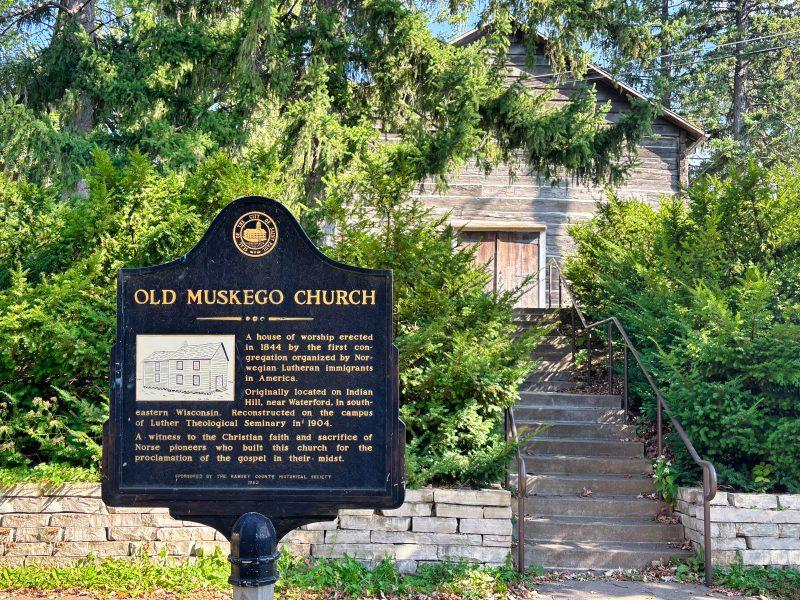
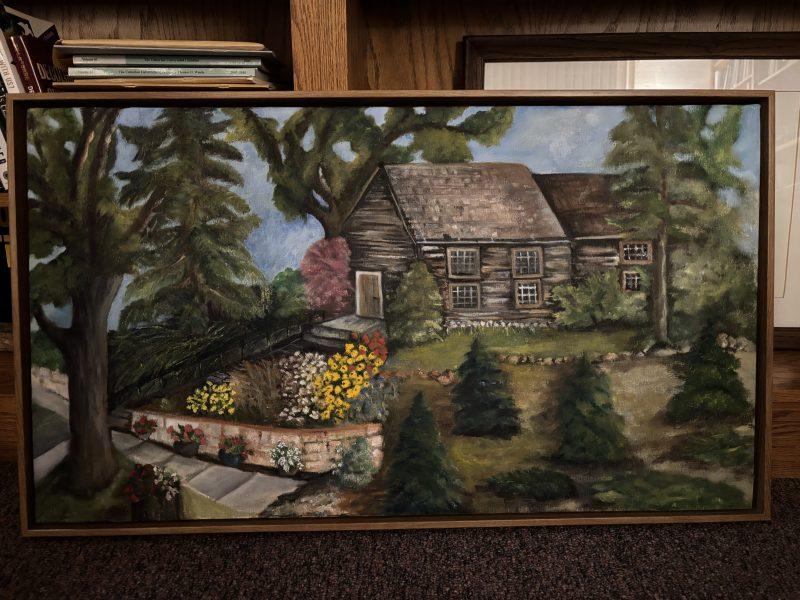
Tucked into the northwest corner of Luther Seminary’s campus stands a hand-hewn log building called Old Muskego Church.
The building was placed on Minnesota’s State Historical Sites list in 1935 and added to the National Register of Historic Places in 1975.
As the seminary prepares to sell its upper campus, the future of Old Muskego is very much uncertain.
According to the St. Paul Heritage Preservation Commission (SPHPC), Old Muskego earned its historic designations for being “the first place of worship of an organized congregation of Norwegian immigrants in America” and for being “an excellent example of pioneer craftsmanship.”
Rachel Farris, director of public relations for Luther Seminary, said in an early October email to the Bugle, “Regarding the future of Old Muskego Church, the seminary is working with a real estate broker to market the Upper Campus, a process that will take some time—potentially a full year or more. While there are still many unknowns to be worked out, at this time, Old Muskego Church will be included in the prospective sale.”
Retired Luther Seminary board member Roger Eggen feels close to Old Muskego. “Oftentimes, as a board member, I’d get the key and take interested people up to see the old church,” said Eggen, a resident of the Zvago housing cooperative next to Luther Seminary. “There were people from all over the world who wanted to see Old Muskego.”
There still are.
Caleb Rollins, current archivist and curator for Luther Seminary, was giving a tour of Old Muskego just a few months ago to an international student whose family was visiting from India. While inside the church, the student’s mother was so moved by the historical significance of the building that she grabbed the nearest broom and began the work of sweeping, caring for the building.
Eggen sees Old Muskego as a symbol of freedom, as many Norwegian immigrants came to the U.S. seeking religious freedoms. And many of those Norwegian immigrants’ descendants are neighbors to Eggen.
“What good has that church been for this community?” Engen asked. “Its symbolic meaning is really big. Old Muskego really does enrich this neighborhood. I think people would miss it if it disappeared.”
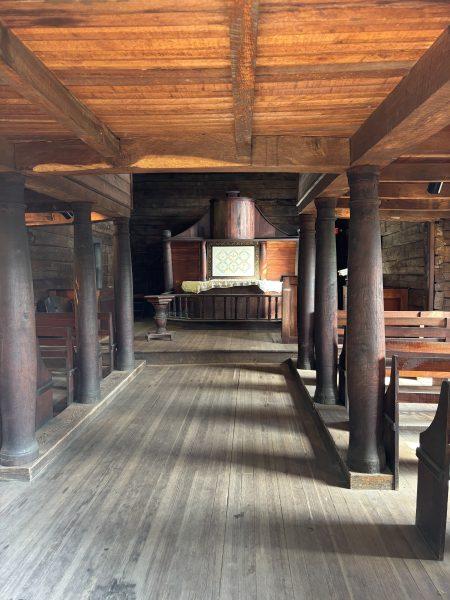
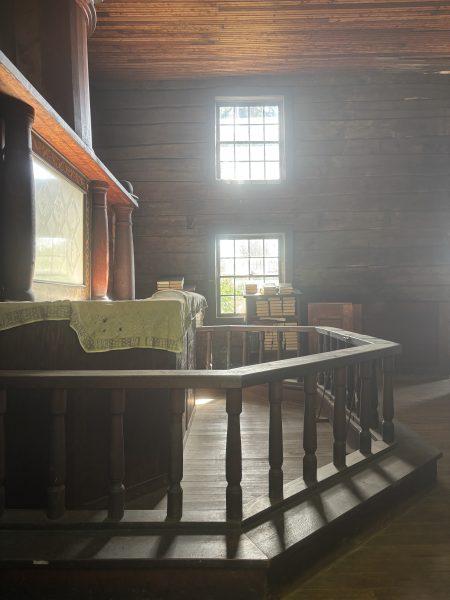
The exterior of Old Muskego is made from red oak logs and the interior is furnished with black walnut. Its two-story sanctuary includes a U-shaped balcony and a large chancel featuring a centered, seven-foot-high pulpit with an altar tucked underneath. Hardanger embroidery displayed in a rosemåled frame is the centerpiece of the altar. The center aisle is defined by six tall, turned walnut columns.
The first group of Norwegians to settle near Muskego, Wisconsin, arrived in the late 1830s, according to the seminary’s website. The community organized a congregation in 1843 when Claus Lauritz Clausen (from Denmark) was ordained as its first pastor.
An SPHPC updated designation study from 2017 reported that the congregation raised $430 to cover the church’s construction costs and “members were highly engaged in the construction process, contributing to much volunteer labor to help reduce costs.”
Original construction of the building was completed in 1844 near Muskego, at the top of “Indian Hill,” a place that was sacred to Potawatomi people, who had by then been displaced.
The congregation outgrew its building in 1869 and built a second one out of brick. The original log church was disassembled and relocated to a nearby farm, where it housed pigs until 1904. At that time it was disassembled again, shipped to St. Paul and restored at its current location.
Today, Norway Lutheran Church, a vibrant congregation in Wind Lake, Wisconsin, traces its origin to Old Muskego. According to their website, “Members of Norway Lutheran Church have made three pilgrimages [to Old Muskego] in recent years to work on preservation efforts and also to worship and commune in the church of our founders.”
Beyond those three pilgrimages, the seminary has been caring for the historic building since its arrival in 1904. (Though, it should be noted that in 1904 Luther Seminary didn’t yet exist. The seminary’s name at that time was United Church Seminary. It was renamed Luther Seminary in 1917 after the merger of three large Norwegian Lutheran groups.)
SPHPC documents note restoration work including removing harmful exterior cladding (1970), a major 1994 campaign that replaced chinking, repaired rotten logs and added rain gutters and sealant and roof repairs and re-chinking in the last 20 years.
Old Muskego has been used as a chapel for seminary students, a practice site for preaching and worship classes, a site for weddings and baptisms, a celebration location for Syttende Mai (Norway’s Independence Day).
Luther Seminary professor of church history, Mark Granquist, brings his classes into Old Muskego.
“It’s a historic artifact and I bring students there so that they can get something of the vibe of what it must have been like to have been in a pioneer church in the 1840s,” Granquist said.
But with the upcoming sale of Luther Seminary’s campus, what will happen with Old Muskego?
According to Farris, the seminary will convene targeted working groups in the areas of strategic, educational and space-related issues related to the sale of the campus.
“These groups will develop recommendations to help us thoughtfully and carefully steward the seminary’s archives, collections and historic assets through this season of transition,” she said.
At Bugle press time, neither Granquist nor Rollins knew if these working groups had begun meeting or who might be included.
“I don’t know the future for Old Muskego,” Granquist said. “But I hope we figure something out. It could be with Luther Seminary. I don’t know if it could go back to Wisconsin where it was from, or maybe a historical society or something like that. I just want it to be taken care of; some sort of place that would look after it and make sure that it’s accessible.”
Sarah CR Clark is a regular freelance writer for the Bugle.
Photo credit: Old Muskego was the country’s first Norwegian-American church and is on both the national and state historic registries. Photo by Norah Clark.

Vi Anne Marie Traynor • Jun 1, 2026 at 6:32 pm
Another possibility would be the Vesterheim in Decorah, IA., The National Norwegian-American Museum, which already has other historic buildings in its care.
Frank Eld • Dec 26, 2025 at 10:15 am
Old world Wisconsin would be an appropriate setting for this historic church.