

By Dave Crawford & Dawn Lamm
Sneezeweed or Helen’s Flower
Latin name: Helenium autumnale
Dakota name: šuŋghúštiphiye zí
(Yellow Horse Medicine)
Used as a poultice for horses’ hooves.
Menominee name: aiatci’a ni’tcîkûn
(In the Menominee language, related to Anishinaabe, “aiatci’a ni’tcîkûn,” translates to “sneezing spasmodically”)
The first question people usually ask about Sneezeweed is, “Does it make you sneeze?”
The answer is: “It can, if you snort it up your nose.”
Sneezeweed blooms at the same time ragweed sufferers begin to sneeze, but they’re sneezing because of ragweed pollen, which is airborne. Sneezeweed pollen is only transported by insects, and you, one would hope, don’t allow insects in your nose!
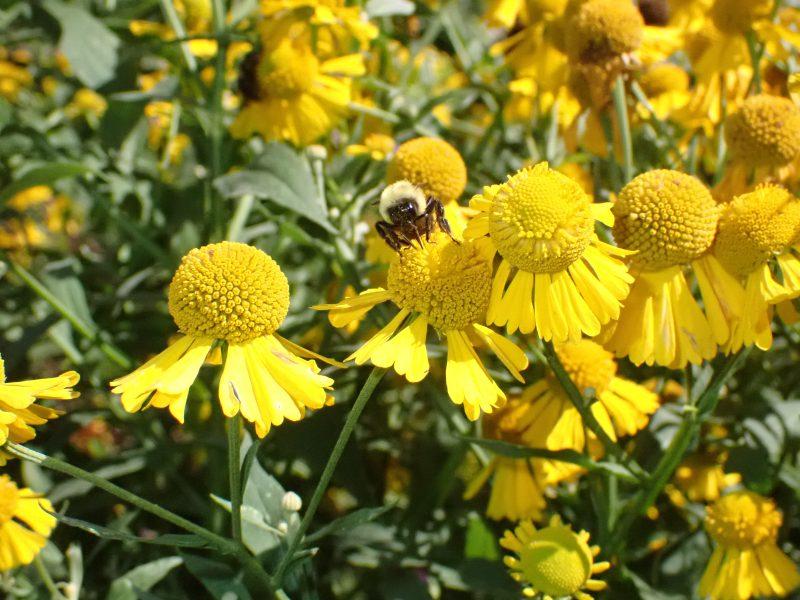
Sneezeweed has bright yellow, daisy-like flowers with short petals. Each petal has three shallow lobes at its tip. The center of the flower is globe-shaped and yellow to brown.
Perennial Sneezeweed can be found in the wild in almost every county in Minnesota. It’s most often found in moist soil with plenty of sun. It can grow well in any garden that’s not too shady or dry. It can grow 2-5 feet tall, so it’s best planted among other tall plants or against a wall or fence.
Red and orange cultivars have been bred for the nursery trade, but the native wild type is pure yellow. Its abundant flowers add cheerful color to gardens, and last well in cut flower arrangements.
The name “Sneezeweed” reflects the plant’s use in Native American and early colonial herbal medicine. Dried flower heads and leaves, if crumbled finely and snuffed up the nose, cause sneezing. This can help expel nasal and sinus congestion and offer some relief in head colds.
In our area, Sneezeweed can begin blooming in early August and continue into October. Its flowers attract bumblebees and other native bees, plus butterflies, flower flies and pollinating beetles.
For many insects that overwinter, sneezeweed, along with late blooming asters, are the last forage before settling in to pass the winter.
The plant has a bitter flavor which tends to make deer and rabbits avoid eating it. It’s toxic in large quantities (several pounds of raw leaves) and can cause poisoning in sheep.
We encourage you to explore saving and exchanging the seed of this wonderful yellow ballerina of October! It’s the most economical way to add to your garden. When the flowerheads are spent and dried along with about 2 inches of the stem, the seeds can be harvested simply by tapping the heads into a container.
Practice responsible seed saving by only harvesting in landscapes you have permission for, and only harvest about 20% of a particular plant or population. Scatter a few seeds to renew the population and share the rest of your harvest with your community.
Sneezeweed, when established, requires less water, are more tolerant of our changing climate and provides forage and shelter for our animal friends while securing water and improving the soil in our landscapes The bright gold of Sneezeweed colors the landscape past first frost, when tender annual zinnias and marigolds have faded.
Thanks to Linda Black Elk, ethnobotanist with North American Traditional Indigenous Food Systems (NATIFS), for the Dakota name and information about its medicinal use in caring for horses.
Dave Crawford is a former Minnesota state park naturalist; Dawn Lamm is founder and organizer of the Como Community Seed Library.
Photo cutline: The bright gold of Sneezeweed colors the landscape past first frost while tender annual zinnias and marigolds have faded. Photo by Dave Crawford.