

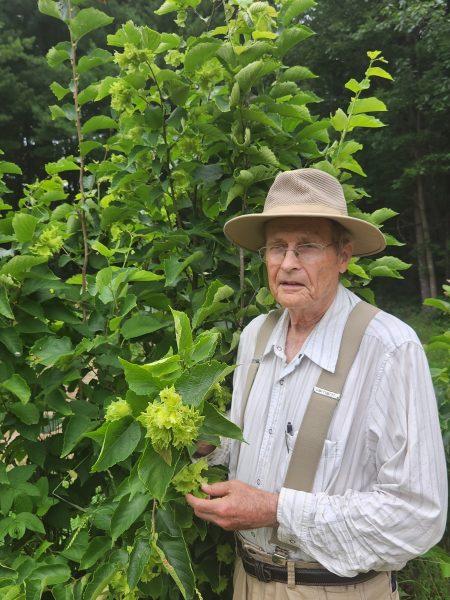
He’s helping to develop commercial hazelnuts
By Gwen Willems
Leslie (Les) Everett, who has lived in Falcon Heights and St. Anthony Park for more than 30 years, has led a fascinating career in agronomy in Africa and at the University of Minnesota.
In retirement, Everett is turning his expertise toward a new passion: pioneering Midwest hazelnut crop production through a joint effort of the universities of Minnesota and Wisconsin.
Within a few years, Midwest hazelnuts could be available.
“Planting of the first commercial demonstration farms with the clonal varieties began two years ago,” Everett explained. “Nut production begins at about year four with full production by year eight. The expansion of commercial plantings will depend on how quickly the two nurseries (Gertens in Minnesota and Hausers in Wisconsin) can ramp up propagation.
“The volunteer work is rewarding, both at the end of a day in the field when you can see physical progress in that day’s operations, and in the plant-breeding sense, when you see new clones that are more productive than previous varieties. It keeps me actively using skills developed over a lifetime, without the administrative burden of being a project manager.”
The drawback to cultivating the two species of hazelnuts native to the upper Midwest and Canada is the small nuts they produce on bushes, he noted.
“Commercial hazelnuts are primarily a European tree species, grown in Oregon and Europe,” Everett noted, “which does not survive in the upper Midwest cold and is susceptible to a fungus that is endemic here and to which the native bushes are largely resistant.”
Some cross-pollinated species of European and American plants have intermediate size nuts, survive the cold winters and are resistant to the fungus.
Everett added, “The UM-UW project began in 2008 by my life partner, Lois Braun, at Minnesota and Jason Fischbach at Wisconsin, systematically evaluating existing hybrid bushes and making new crosses. The best producing bushes are cloned, further evaluated and ultimately turned over to two nurseries for production of plants for sale.”
Everett’s interest in agriculture began when he grew up on a farm where he and his brothers did livestock chores before and after school as well as field work in the summer and on weekends. As an undergraduate in agriculture at Iowa State, Everett joined ROTC and after graduation, was commissioned in 1970 into the Army Medical Service Corps, where he was an administrative officer at Walter Reed Army Hospital.
Everett joined the Peace Corps in 1973 to see if international agricultural development was a good fit for him. He worked for two years speaking French and Swahili in Zaire (now Congo), gaining experience in tropical agriculture and becoming acquainted with the work of international agricultural research centers.
Subsequently, Everett went to graduate school at Cornell and then the University of Minnesota, focusing on crop physiology and plant breeding.
“Major advancements were being made in agricultural research for developing countries through the work of scientists like Norman Borlaug with his wheat breeding in Mexico and others in rice breeding in the Philippines,” Everett told the Bugle. “Plant breeding provides tangible results (new varieties) that can improve lives and livelihoods.”
Upon graduation in 1982, Everett began a decade of work with the International Institute of Tropical Agriculture (IITA), based in Nigeria and Cameroon. There he developed new corn varieties adapted to tropical growing conditions and devoted much of his time to training young Cameroonian researchers and technicians.
The last 25 years of Everett’s work was as a conservation agronomist at the University of Minnesota, where he worked on projects including conservation management of tillage, fertilizer, manure and agricultural drainage.
A researcher at heart, Everett recently wrote a letter to the editor of the Minnesota Star Tribune, saying, “the current U.S. Administration’s approach to research is what an African farmer would call ‘eating our seed.’ Those farmers know that if you eat the seed now that is needed to plant the next crop, you will starve next year. Without research investment now, there are no new discoveries in medicine, agriculture or any other sector.”
Gwen Willems lives in Falcon Heights and is a writer for the Park Bugle.
Photo caption: Leslie Everett with a hazelnut bush. Photo by Lois Braun.