

By Kerry Morgan
June marks the rainiest month of the year, when an average of 4.34 inches falls in the Twin Cities.
But averages reflect the past, and today we’re experiencing longer droughts and heavier rainfalls due to climate change.
Conserving water and dealing with large volumes of stormwater are growing concerns, especially when the runoff contains pollutants like dirt, fertilizers, pesticides, pet waste, chemicals and garbage.
These pollutants can’t be traced to just one specific source; they travel along hard surfaces and end up in our lakes and rivers.
While there’s no singular solution for water pollution or a perfect strategy to prepare our infrastructure for unprecedented volumes of water, there is a relatively inexpensive and accessible option for almost anyone with a yard: installing a rain garden, or two.
Rain garden basics
Unlike regular gardens, rain gardens are low-lying areas designed and planted to temporarily hold rainwater that flows from roofs, driveways, patios, lawns, and even streets. Properly constructed, they let the collected water seep into the ground over a 24- to 48-hour period (too quickly for mosquitoes to breed).
The vegetation and soil slowly percolate and filter the water, recharging the groundwater supply and removing pollutants that might otherwise reach a local waterway.
Several factors play into the design of a rain garden: site, size, shape, soil and plant selection. Native shrubs, grasses and wildflowers provide the greatest ecological benefit since they are already well adapted to the local environment, require no fertilization, have long roots to help prevent erosion and will attract the widest variety of pollinators and birds.
The University of Minnesota Extension offers useful guidelines (See extension.umn.edu/landscape-design/rain-gardens) and soil testing. Rain garden templates are available from the nonprofit Blue Thumb, which also hosts free or inexpensive online and in-person workshops (bluethumb.org).
Local resources make it easy and affordable
A rain garden can be a self-funded DIY project, but watershed districts may offer property owners technical and financial assistance.
Most of the Bugle’s readers live within the Capitol Region Watershed District (CRWD), and they have taken advantage of these cost-sharing grants for decades, with almost 50 rain gardens in St. Anthony Park supported by CRWD grants (capitolregionwd.org/grants/clean-water-project-grants/).
Two-time recipients of CRWD grant funding are north St. Anthony Park residents Maria Wolff and Eric Kloos.
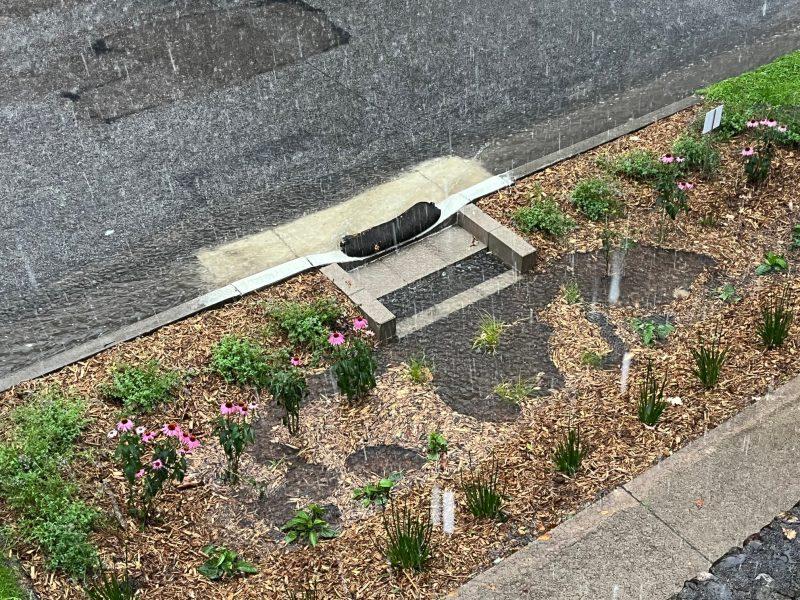
More than 15 years ago they used a Clean Water Project grant for a backyard rain garden. That success inspired them to apply again, this time for a curb-cut boulevard rain garden. These are installed between the sidewalk and roadway and require coordination with a city’s public works department to open the curb.
For the Wolff-Kloos family the whole process, from application to installation, took about 10 months. As a homeowner, they paid only 5% of the cost.
Wolff has been pleased with the results. Little maintenance is required: weeding in the late fall, leaf removal in spring and removing street debris at the inlet monthly.
And the effects were immediate.
After rainstorms, “the water is absorbed in a matter of hours,” Wolff said, and they see “a lot of pollinator action in late summer, with monarchs and bees specifically.”
CRWD, which monitors the curb-cut rain gardens, reported that the 145-square-foot rain garden diverted 2,722 cubic feet of stormwater in one year.
CRWD has coordinated over 300 new curb-cut rain gardens in its watershed. Some are part of a major street renovation, such as the reconfiguring of Raymond Avenue in 2015 that established the two large community rain gardens maintained by the St. Anthony Park Community Council.
These recently revitalized rain gardens, along with the sizable curb-cut boulevard rain garden at 2350 Bayless Place, will be featured in the upcoming St. Anthony Park Garden Club Tour on Saturday, June 28, from 10 a.m. until 3 p.m.
Perhaps a walk through the neighborhood will inspire you to apply for your own Clean Water Project Grant.
Kerry Morgan is a board member of the St. Anthony Park Community Council, a Ramsey County master gardener and a Minnesota water steward.
Photo credit: The newly installed curb-cut rain garden at the Wolff-Kloos residence at 1521 Chelmsford Ave. is helping filter stormwater, reduce local flooding and beautify the neighborhood. Photo by Eric Kloos.