

By Bill Brady
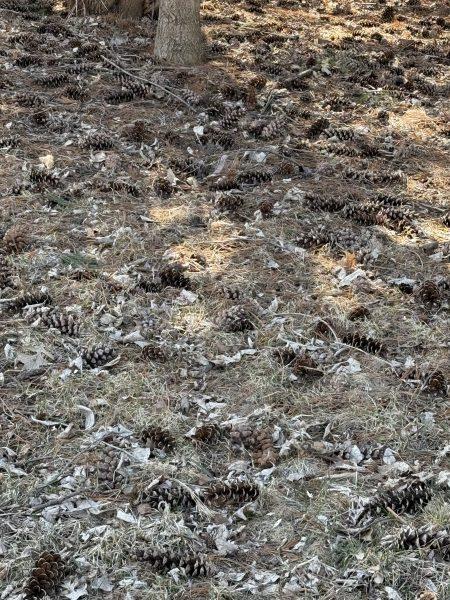
As winter turned to spring in our St. Paul neighborhoods this year, the melting snow revealed an unusual plethora of pine cones dotting the landscape of many evergreen-heavy yards.
The more evergreens in the yard, the thicker the carpet of brown seemed to be.
With eight 50-to-60-foot pine trees adorning his lawn, Kenneth P. of Roselawn Avenue certainly noticed.
“Yes! Very heavy on dropped pine cones this year,” he said in a NextDoor conversation. “Since last year’s bizarre weather and lilacs blooming twice, I wonder if the pine trees did the same.”

Kenneth is onto something. According to University of Minnesota Extension Horticulturist Brandon Miller, the overabundance of those tiny trees-in-waiting is, quite likely, a product of last fall’s “bizarre weather,” specifically the lack of moisture.
“We have had droughts for several summers in a row,” Miller noted, and often organisms respond to drought by “focusing their energies on reproduction. It’s kind of a last hurrah to reproduce,” in case they don’t make it. Ironically, this activity further depletes their stored energy, making that outcome more possible.
Miller cautioned, however, that highly variable fruit production by trees and shrubs, known as “mast seeding,” is not unheard of, and climate is only one possible factor.
“People for centuries have been figuring out why trees will do this,” he said. “There are lots of theories.”
Drought seems to induce excessive seeding. But other explanations include the so-called Predator Satiation Hypothesis: Essentially, if the trees sense a lot of predators, they will overproduce seeds to improve the chances that some seeds can escape consumption.
When you read “predator,” think “squirrel.” Diane S. of Como Park sees abundant evidence they’ve made several stops at her pine cone buffet.
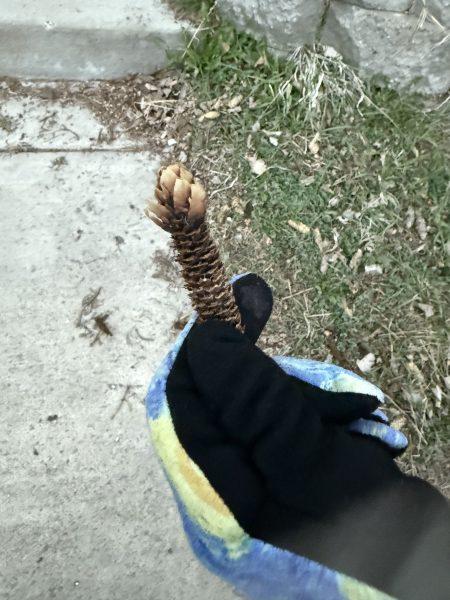
“Squirrels in my yard have eaten them right down to the core,” she said. “There are lots (of cones) in my yard that are down to just the core of the pine cone.”
That could mean more and chubbier squirrels for a while. But the good news about mast seeding is that it is typically followed by years of below-average seeding, which tends to keep predator populations in check.
Even if dry weather was the primary cause of this year’s excessive cone drop, “There’s no need to hit the panic button just yet,” Miller said. “It is, however, a good reminder to check and make sure the trees are getting the water they need and aren’t getting stressed out.
“In general, the younger, less established plants are more vulnerable to droughts. So, give them special attention.”
For up-to-the-minute advice on attending to your trees’ health, visit the Extension lawn and garden web site, extension.umn.edu/yard-and-garden.
Bill Brady lives in Falcon Heights and is the Park Bugle’s copy editor.
Photo credit: An abundance of pine cones fell to the ground in the wake of a fairly dry winter season in the Twin Cities. Photo by Bill Brady.
