

By Michael Russelle
How would you know healthy soil if you saw it? Healthy soil has:
• Good water infiltration with little runoff.
• Fast drainage, allowing for steady aeration.
• The capacity to store water, reducing plant drought stress.
• The ability to filter and process potential pollutants.
• Efficient nutrient cycling—storing, releasing and recapturing nutrients
• Good physical stability that provides space and support for plant roots and reduces damage by erosion.
All these characteristics help healthy soil sustain plant and animal life. So, if our soil isn’t healthy, how do we get it there?
Maximize biodiversity, soil cover and living roots
Natural ecosystems have a diversity of microbial, fungal, plant and animal species that are suited to the site. That complexity produces synergistic benefits that enhance growth and efficient use of nutrients and water.
We can approach this goal by having mixtures of plants in the garden, or at a minimum, by rotating crops.
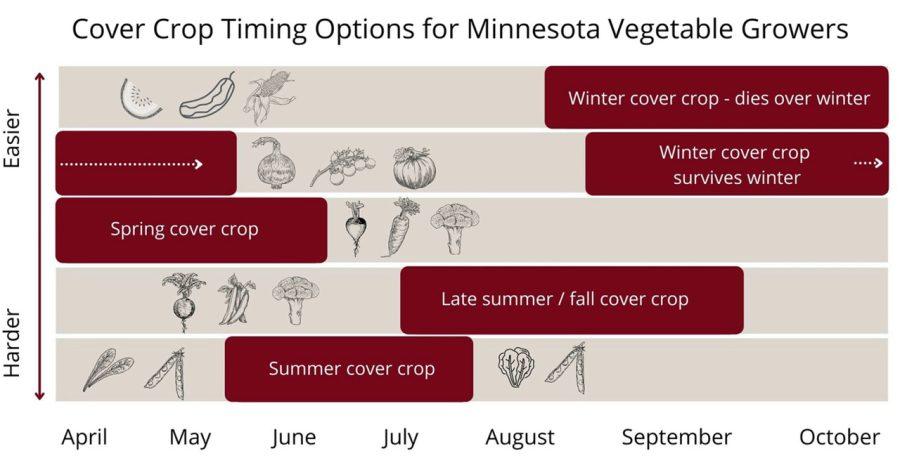
In your garden, the best way to maintain cover and living roots outside of the main growing season is to plant cover crops, such as oats, hairy vetch, winter rye or peas.
An excellent resource with more details—also the source of the UMN Extension chart shown here—is available at bit.ly/3G3bO21.
We can’t do much to change soil texture: the proportions of sand, silt and clay. But we can add more organic matter in the form of compost, which will benefit nearly every garden.
Even better is to promote soil aggregation, which provides most of the benefits to soil health.
Soil aggregates, or crumbs, are stable combinations of minerals and organic matter that stick together more than to neighboring particles. When you squeeze a moist “dirt clod” it crumbles into its component aggregates.
Among the myriad organisms in soil, there are symbiotic mycorrhizal (fungus-root) fungi living in plant roots. The fungus benefits from sugars from the plant, while the plant benefits from nutrients like phosphorus the fungus absorbs from outside the plant root zone.
Mycorrhizal fungi produce small-diameter hyphae that grow into the surrounding soil, extending far beyond the single-celled root hairs that protrude only a few millimeters from the root surface.
My research team once found several yards of fungal hyphae per inch of root length in alfalfa! These hyphae permeate the soil and contribute to aggregate formation.
About 30 years ago, federal research soil scientist Sara F. Wright discovered the “super glue” that is largely responsible for holding soil aggregates together. She named this material “glomalin” because it is exuded from the growing hyphae of the Glomus genus of mycorrhizal fungi.
Glomalin is a mixture of glycoproteins (proteins with sugar subunits) and contains 35 to 40% carbon. It is strong and stable. Some estimates say it can persist for as long as 50 years, long after the fungus and plant have died and decomposed. In healthy soils, glomalin comprises up to a third of the stored soil carbon.
Minimize soil disturbance
How can you encourage mycorrhizal fungi in a garden? Reduce tillage. Keep phosphorus supply moderate. Plant other vegetables for a few years after brassicas and mustards, which do not support mycorrhizal fungi.
Don’t overwork the soil. It is best is to avoid tillage if you can (see the Park Bugle article by Lois Braun at bit.ly/3QSQMpl). If you till, use a spading fork instead of a shovel, or use a shovel instead of a rototiller. Avoid tillage and foot traffic when the soil is wet—either will increase soil compaction.
High phosphorus supply in the soil limits mycorrhizal fungi growth because the host plants can acquire sufficient phosphorus without having to feed the symbiont. If your soil test (bit.ly/4jcBF5Z) shows high phosphorus, don’t worry, but don’t apply more.
There are scores of soil additives that claim to boost the soil microbial and fungal populations, but you should be skeptical. For example, research at the University of Kansas (bit.ly/4hX4liq) found that most products that claimed to contain mycorrhizal fungi did not produce hyphae in the greenhouse and several contained plant pathogenic fungi.
Be patient. It may take a few years to nurse your soil back to health.
Michael Russelle is a retired soil scientist and co-chair of the St. Anthony Park Community Council’s Environment Committee.
Photo: Cover crop selection for vegetable growers. Source: UMN Extension website, bit.ly/3G3bO21.