
By Tracy Kugler
Exciting new projects are underway thanks to the Transition Town—All St. Anthony Park Collaboration Lab.
Last winter, community members gathered twice to develop ideas for neighborhood projects that foster better relationships with each other, with our more-than-human neighbors and with broader social and ecological systems.
Participants brainstormed over 100 project ideas. Each person then organized the ideas into related groups and ranked them in terms of impact, feasibility and their own personal commitment.
Group concept map
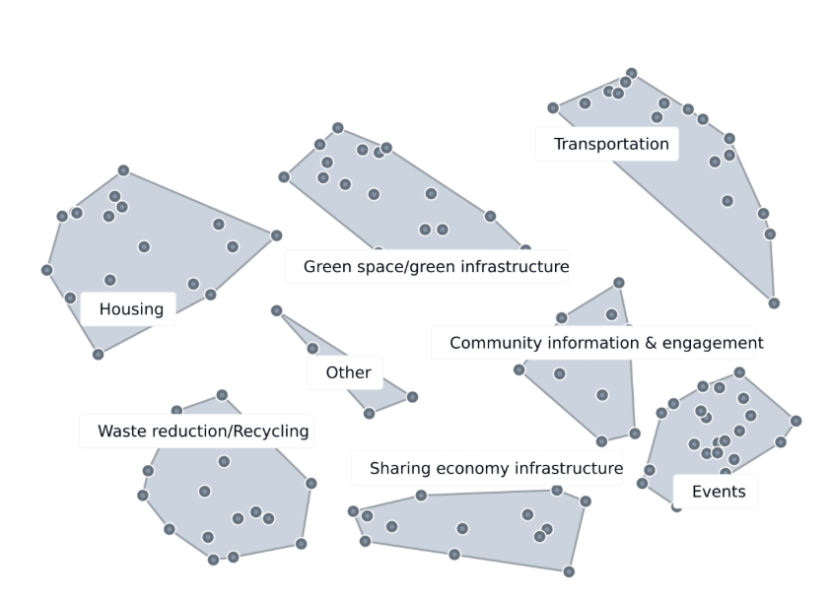
The individual groupings were summarized to create a “group concept map.” Each point on the map represents a project idea. The more individuals placed two ideas in the same group, the closer those two points are to each other.
Clusters of nearby points are grouped together to identify overall themes. Our group concept map includes eight themes: 1) housing, 2) green space/green infrastructure, 3) transportation, 4) waste reduction/recycling, 5) sharing economy infrastructure, 6) community information and engagement, 7) events, and 8 an “other” category including ideas that tended to be grouped inconsistently.
Working groups
Groups then organized themselves around themes they were interested in and began planning selected projects. Four working groups emerged. If you are interested in getting involved with their work, please contact the person listed for the group.
Housing: This group is exploring options for networked geothermal systems to provide carbon-free heating to clusters of homes. Ideas include working with Cooperative Energy Futures on a bulk purchase of groundwater source heat pumps for homes along Cleveland Avenue, or considering networked geothermal for new development on the Luther Seminary lower campus.
The group will also continue on-going TT-ASAP work around education and resource sharing for home electrification. Contact Tim Spanier, [email protected].
Green space: This group aims to cultivate the biocultural uniqueness of St. Anthony Park by enhancing tree canopy and other green spaces. The first step is to identify areas around the neighborhood where new trees or gardens could be planted.
The group is also continuing efforts to advocate for more eco-friendly options for the University’s Les Bolstad golf course. Contact Mark Robinson, [email protected].
Transportation: This group is working to make transit, biking and walking more approachable. Initial projects include creating posters to be displayed at local businesses showing where you could get to in 30 minutes using transit, walking and biking; and hosting a program to let community members experience an e-bike lifestyle by borrowing an e-bike for a week.
Other ideas include identifying sites in front of local business for city-installed bike racks and organizing group bus/and train rides to help people get familiar with transit options. Contact Pat Thompson, [email protected].
Waste reduction and recycling: This group plans to talk to local restaurants and groceries about their food waste practices; establish Terracycle sites in the neighborhood (sites for recycling hard-to-recycle products); and organize tours of recycling facilities such as Eureka, WestRock cardboard recycling, and St. Paul’s municipal compost processing. Contact Margot Monson, [email protected].
Explore the full set of brainstormed ideas and the impact, feasibility, and personal commitment ranking data on the TT-ASAP website at www.transitionasap.org/collaboration-lab. If you are inspired by another project idea and want to connect with others to work on it, contact Tracy Kugler, [email protected].
Tracy Kugler lives in the Como Park neighborhood and loves trees, birds and maps. She is a research scientist in the Institute for Social Research and Data Innovation at the University of Minnesota.
Photo caption: A group concept map organized the brainstormed ideas into eight themes. Graphic courtesy of Transition Town-All St. Anthony Park.