

By Jenni Wolf
I hesitate to mention the “W word”, winter, because it is not here yet – we technically have until Dec. 21, right?!
However, I don’t want to delay talking about one of my favorite foods of the season – winter squash.
These brightly colored, uniquely textured orbs have been showing up on farmers market tables, grocery store shelves and maybe even in your CSA box for at least a month now, begging to be included in your cool-weather meals.
There are myriad varieties of this fruit (yep, it’s technically a fruit!) and endless ways to enjoy it –so many that sometimes it can be hard to know where to start.
Let’s chat about of some of my favorite approaches for how to pick ‘em, how to store ‘em, and how to enjoy ‘em.
Winter squash is harvested in late summer through fall and can be stored for months into winter because of its hard exterior shell. When selecting squash, look for a fruit that is firm, heavy- for- its- size, free from soft spots and is a deep, but dull or matte color.
Also check the stem – it should be dry and could be frayed or have the appearance of cork. These are all signs that the squash was left to ripen on the vine and then cured appropriately for winter storage. Once you get your squash home, store it in a cool, dry place and plan to use it within the month.
The most common types of winter squash available in Minnesota are butternut, acorn, delicata, and spaghetti – but there are many more too! All squash varieties are rich in fiber, potassium and antioxidants, among other things, making them a nutrient-dense choice. They are lower in starch or carbohydrate compared to a potato but do offer more than summer squash.
As a dietitian, I view winter squash as either a vegetable or a starch on my plate, making them easy to include in a balanced meal.
Squash can be roasted, sautéed or steamed. If sautéing or steaming, peel your squash first — unless it is a delicata, in which case the skin is delicate enough to eat if you’d like. Roasting is my favorite method as it does not require peeling, although you can peel and cube prior to roasting if you prefer.
Wash and dry your squash to ensure it is clean before cutting. Then cut the squash in two with a long, sharp knife lengthwise to create two halves. Use caution, as this may be difficult due to the hardness of the outer skin. You can microwave your squash for a few minutes to gently soften the skin and make cutting easier – just be sure to poke a few holes in it so that it doesn’t explode.
Next, scoop out the seeds of the squash – you can roast these if you’d like for an easy snack or salad topper. Season the flesh of the squash with olive oil or butter and seasonings of your choice.
Place squash cut-side down on a lined baking sheet and bake at 400 degrees until flesh is tender – length of time will depend on the size of your squash. Don’t worry if the skin blisters and blackens – you won’t be eating it anyway and the higher oven temperature allows for caramelization to occur.
When the squash is tender, scoop out the flesh and eat it as is or puree to use in a soup or casserole.
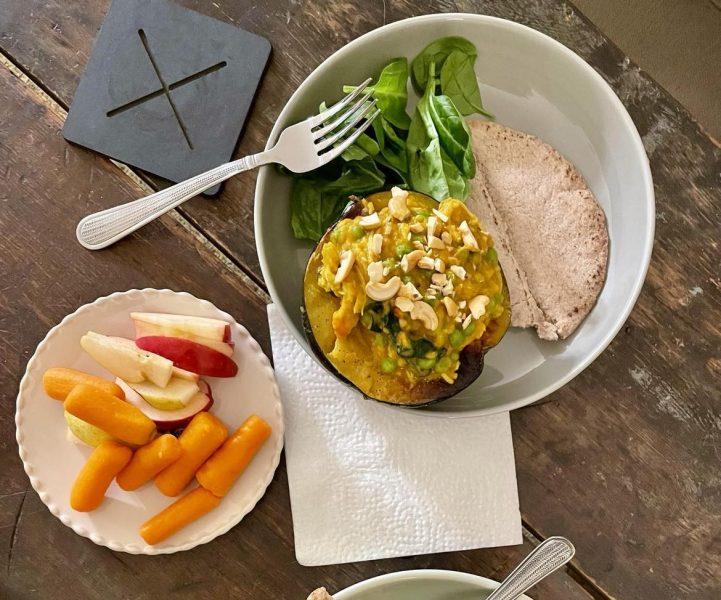
Another favorite preparation method of mine is to “stuff” the roasted squash halves with a pilaf of quinoa, roasted chicken, sauteed veggies, dried cranberries and pecans – it’s fall in an edible bowl!
Squash also makes an excellent addition to many classic favorite winter dishes – add caramelized, sauteed squash to a hardy kale salad, simmer some in your go-to chicken noodle soup recipe and replace your favorite mashed potatoes with a mashed-squash variety.
Leftover cooked squash can also find its way into breakfast – throw some into a quick hash with eggs or puree and stir into oatmeal, yogurt or pancake batter to lean into its natural sweetness.
So, cozy up and get to cooking; winter can’t get us down, we’ve got squash on our side!
Jenni Wolf, a registered dietitian, writes about food and nutrition for the Bugle.
Photo caption: Stuffed squash: Try your favorite curry or stew recipe—but serve it in a squash! Photo by Jenni Wolf.
