

By Kathy Henderson
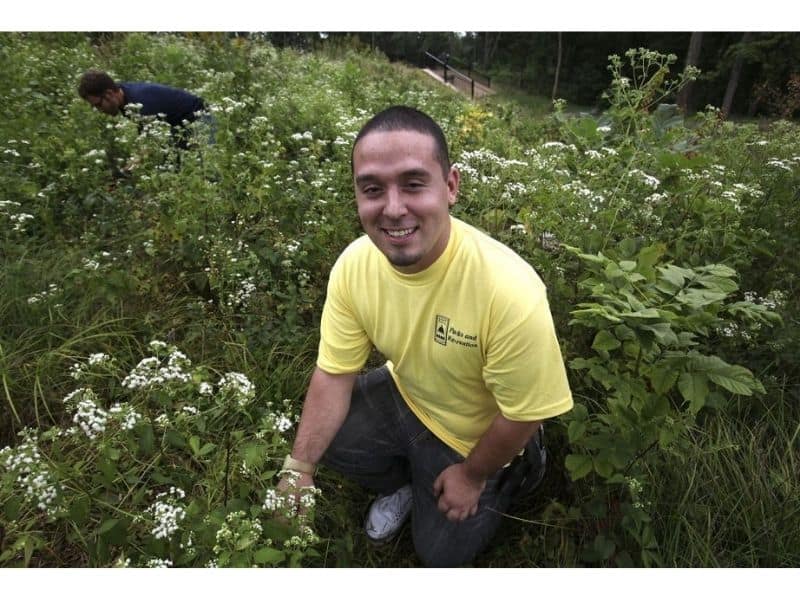
On the second anniversary of getting named director of St. Paul Parks and Recreation, Andy Rodriguez stopped in early June at College Park in St. Anthony Park for an informal chat about the park’s history and its place in today’s parks system.
Rodriguez, described in local news stories as one of the youngest directors of the parks system and the first Latino, oversees 184 parks and open spaces—plus even more in its buildings, trails, beaches, golf courses, sports and aquatic facilities, and Como Zoo and Conservatory.
Last May, the Trust for Public Land rated St. Paul as the “second-best public parks system in the nation.”
Rodriguez had before visited College Park, 2223 Carter Ave., but not in a while. “This is one of our older parks,” he said.
College Park joined the parks system in 1907, largely due to the intercession of St. Anthony Park residents, led by University of Minnesota Professor Samuel Green, whose home was near the park.
College Park’s terrain is undoubtedly one of the most unusual of any neighborhood park. Walking around its circumference, you’ll find the sidewalk along Carter Avenue borders the park at tree-top level. Walk along the eastern border on Raymond Avenue and you can also look down on the parkland, providing an exceptional view for watching the players on the courts.
However, park users can also enter at street level from Doswell Avenue, which borders the north side. But if you continue along the Doswell dirt path, you’ll be tree top level again. And toward its eastern edge sits a large grass-covered, bowl-shaped area edged by trees, reputed to be a superb spot for winter sledding.
Lost lake, a tax forfeit and a Green rescue
Sorry to disappoint science fiction fans, but that peculiar depression in College Park isn’t due to some otherworldly or meteoric occurrence.
Instead, it is evidence that in the mid-1880s, a two-acre body of water called Partridge Pond needed to be drained.
During that era, it was common for the Board of Health to authorize Public Works city engineers to attend to ponds, giving drain-and-fill orders in response to “sanitary demand and public sentiment” under “abate nuisance of stagnant and impure water.” It would have been considered a sensible public health action when there was a fear that unsanitary conditions—such as stagnant water—caused fevers and sicknesses such as diphtheria, scarlet fever and cholera.
The story goes Partridge Pond became Partridge Park. But that name didn’t stick. Located so close to the University of Minnesota’s Agricultural College on the St. Paul “farm” campus, it wasn’t long before it became known as College Park.
By 1906, the vanquished pond and surrounding land was on the tax delinquent roll.
Professor Samuel B. Green, who had resided with his wife, Alice, at 2095 Commonwealth Ave. ever since the U hired him as its first horticulture professor in 1888, was concerned about future ownership and what might be developed on that site.
Thus, Green rallied his neighbors to chip in, buy the property and donate it to St. Paul’s Board of Park Commissioners. It was officially established as College Park on May 14, 1907.
While the purchase and donation went as planned, College Park remained what was described as an “undeveloped eyesore.” It was becoming known as Green’s Folly.
With that mocking attack on his good intentions, Green took action again, this time in 1908, donating trees and shrubs to be planted in College Park. The park board authorized the labor to plant them at a cost of $88.79 (equivalent to $3,026.08 today).
Also, Green’s intentions for College Park went beyond creating pretty parkland.
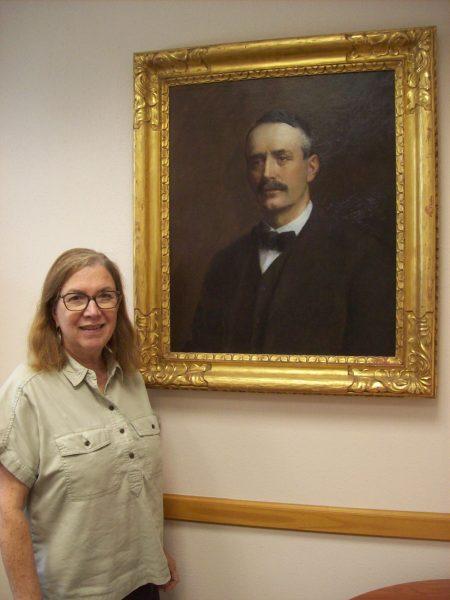
“Professor Green purposely designed College Park to be used as a teaching park,” said Kristen Nelson, interim head of the U’s Department of Forest Resources. A 1910 portrait of Green, who was the U’s first Forestry dean, is on the wall outside her office at Green Hall, a building on the St. Paul Campus that was dedicated in Green’s honor in 1938.
Over the years, others have added trees and plantings to College Park for aesthetics and for teaching, Nelson said. Today, University students still use College Park as a resource for dendrology (the scientific study of trees) field study.
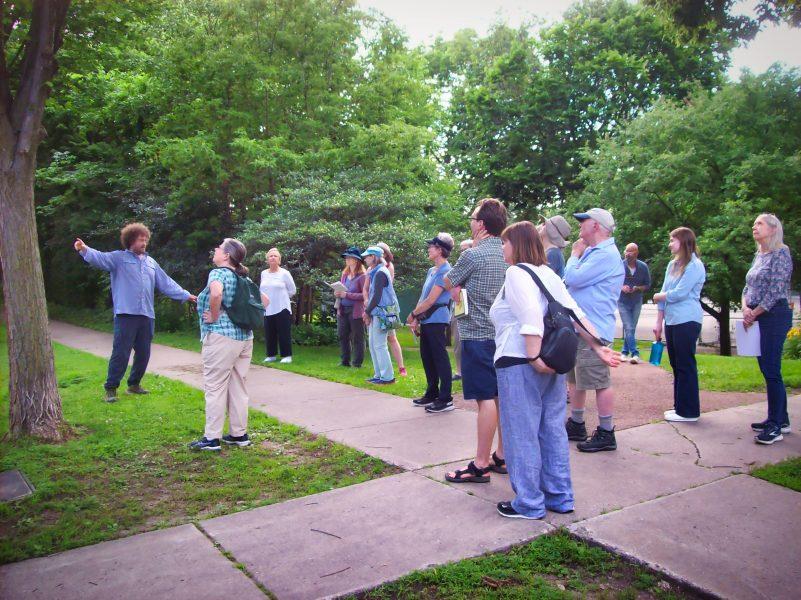
District 12 Community Council’s Environmental Committee scheduled a Tree ID Walk on July 10. In 2021, its tree inventory listed 147 trees in College Park, including 111 deciduous of 14 varieties (counting 50 Burr oak) and 36 coniferous pines, spruce and cedar.
Tribute stones
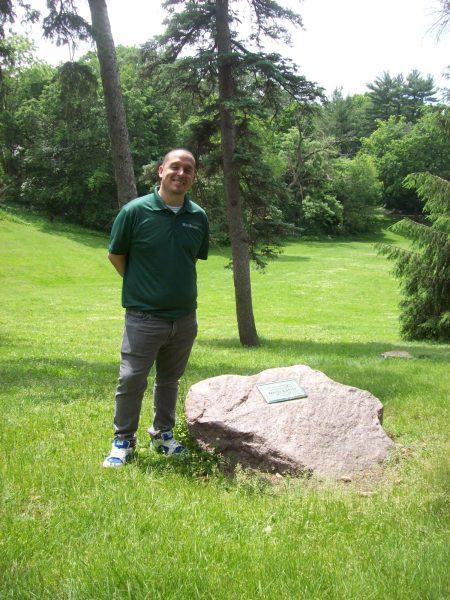
During his walk around the park, Rodriquez looked at the granite tribute stones that were placed in College Park 100 years ago, on May 11, 1924, by the St. Anthony Park Improvement Association in recognition of its past presidents: Green, LeRoy Cady and Gilbert Gutterson.
Located close to a grove of blue spruce, the largest stone reads: “This park and these trees perpetuate the memory of Samuel B. Green, 1859–1910.”
In 1933, former St. Paul Parks Superintendent George Nason reflected on Green’s contributions to College Park: “A hole in the ground does not teem with decorative value. Yet Samuel B. Green, eminent Minnesota horticulturist, did see the possibilities in such a hole.
“The blue spruce he planted are an ever-rising monument to his memory. … College Park contains the greatest concentration of the blue spruce of Colorado to be found in the environs of St Paul.”
In a 1924 photo, the blue spruce trees surrounding Green’s tribute stone look just a bit larger than household Christmas trees and are so close together that their branches seemed to touch. Today, those trees soar so high one needs to tilt their head way back to see the tops.
It is poignant that Green, a visionary who was instrumental in saving 100-year-old red pine trees for the U’s field research facility at Cloquet Forest, now has trees over 100 years old surrounding his tribute stone.
The tribute stone to LeRoy Cady faces toward the Cady family’s former residence at 2121 Doswell Ave.: “The community planted this tree in memory of LeRoy Cady, 1879–1923.” Whatever tree was once there is now gone.
Cady, a U graduate who went on to become a professional colleague of Green’s, was once praised by St. Anthony Park resident William Boss for his “great interest in neighborhood affairs,” noting that Cady “was instrumental in securing graded streets, sidewalks, trees on boulevards and many other improvements which made his community a highly desirable place in which to live.”
In bittersweet happenstance, Green’s and Cady’s lives ended while each man was doing the work he loved in the place he loved to be in.
Green died at age 51 of a stroke while he was at Itasca Park, where construction of the U’s forestry research station was just getting underway.
And Cady, who had “labored unceasingly for the upbuilding of the (Horticulture Society’s) flora exhibits” at the Minnesota State Fair, was stricken with a ruptured gastric ulcer on Sept. 8, the final day of the 1923 Fair. Hospitalized, he passed away on Sept. 12 at age 44.
Gilbert Gutterson, the recipient of the third 1924 tribute stone, lived at 2181 Doswell Ave. He was a local businessman, community leader and former Minnesota legislator (Mankato/Blue Earth). Gutterson Elementary School, once located at Como and Commonwealth avenues, was named in his honor. He died of a stroke in 1923, leaving an endowment fund to the St. Anthony Park Methodist Episcopal Church.
Neighborhood gem
“Serene” is how Rodriguez first described College Park’s surroundings on that 80-plus-degree Tuesday afternoon he visited.
But that serenity was only a lull. A short time later a group of youths ran across the park to the play area and a couple with tennis rackets strolled toward the courts.
“This is what a neighborhood park should be: open space, play area, courts; a place you could read a book, hang out, have a picnic,” Rodriguez reflected.
The play area was established in 1964 and the current look is from 1997, he said. The courts were redone in 2001; could be time for a redo, he mused.
As our walk around College Park ended, Rodriguez noted, “This park is amazing. There is nothing we (parks system) would want to touch in its open space … You have a gem here.”
Kathy Henderson lives in St. Paul and is a Bugle freelance writer.
